Gilad Erdan sat down with Mishpacha for a discussion of his unenviable job
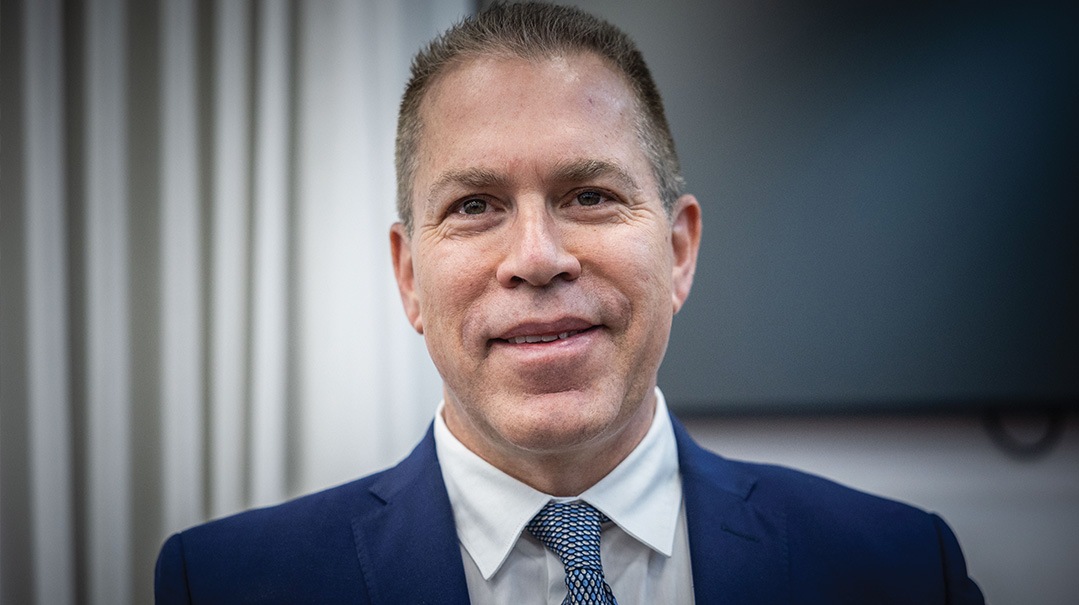
Erdan finds himself representing Israel at its toughest moment in 75 years, after the worst massacre of Jews since the Holocaust. Facing an organization whose secretary-general casts Hamas, today’s Nazis, into the role of victims, and portrays the real victims as the aggressors, Israel’s UN ambassador has an almost impossible task.
Gilad Erdan sat down with Mishpacha for a discussion of his unenviable job. The conversation began on a pessimistic note, but there was a ray of light at the end of the tunnel.
That’s just one more example of the secretary-general trying to create a perverse, insane, and immoral equivalence between a terrorist organization and a democratic member state of the UN, exercising its right of self-defense to prevent a repetition of the massacre.
By arguing for this unholy “balance,” every day he himself provides the justification for my call for his resignation. This is why I must continue to expose his hypocrisy and double standards and limit his influence as much as possible.
Guterres is the former prime minister of Portugal and led the Portuguese Socialist Party at a time when it was positioned on the extreme left. He holds radical left-wing positions. Even before October 7, I clashed with him repeatedly when he held fundraising events for UNRWA and claimed that children in Gaza have no prospects and that we shouldn’t be surprised if they join ISIS. Just insane and irresponsible statements that show you what his worldview is.
I have no evidence or information about secret dealings with Qatar, but there’s definitely a lot going on under the radar. You have to understand that there are 56 Muslim countries in the UN, almost a third, against a single Jewish state. And the leaders of these countries support the Palestinians, not because they’re in favor of Hamas — most of them know the truth — but in many cases because they’re petrified of a popular uprising or coup, because these are not democratic countries.
That characterization doesn’t accurately reflect the whole situation. We’re almost half a year into the war, and apart from the horrific massacre of October 7, the world has only been seeing the images of devastation in Gaza — which is a sign of Israel’s military progress. But that’s what the world sees, so all the political pressure is on the leadership of Western countries. And you’ll note that despite this, no resolution calling for a cease-fire has passed, and we’ve been fighting continually for six months.
When it comes to the Security Council, the key thing is to maintain contact and dialogue with the United States. Because with all our disagreements — and there are some — the United States is the only country we can count on to exercise its veto power. Not Russia or China, that’s for sure, and unfortunately not even Britain or France. Those are the five permanent members of the Security Council. The United States is the only one willing to use its veto even when the Russian and Chinese put together a huge Security Council majority in favor of a cease-fire, or against condemning Hamas.
I’m working constantly to find creative ways of exposing the truth, by bringing the families of the victims of the horrific violence of October 7 here, among other ways.
As an unelected official, I won’t pass judgment on the political side. I myself was an elected official for many years, and I hope to be again, and I don’t think that those in professional positions, like myself, should express their opinions about the political side.
Speaking to the issue, I think it’s no secret that bipartisan support for Israel is a strategic asset. You can see it even now — and I’m not downplaying the disagreements. It’s clear that the war’s having a real political impact on the United States presidential election, with President Biden under huge pressure from Muslim communities in key states like Michigan and Minnesota. So the administration, more and more, wants to come across as mediator, both by promoting a cease-fire and by increasing the humanitarian aid to Gaza.
Not every disagreement is a clash of interests. We’re cooperating with the request to increase humanitarian aid, for example, because that’s in our interest too.
But where our interests are at stake, like, for example, when the Americans talk about avoiding a military operation in Rafah, the prime minister has been very clear. And he said this publicly, even after his conversation with President Biden, and I also say this on every platform — that Israel must act in Rafah. Because without an operation in Rafah, we won’t be able to dismantle Hamas’s military and governmental capabilities, which would make another massacre only a matter of time. We didn’t embark on this campaign and pay such a heavy price in the lives of our soldiers to end up in the same position as before.
It’s not that we’re waiting for American approval. Rather, we want the Americans to feel that we’re listening to them and we’re willing to examine their proposals. And if the American administration has a plan for how to destroy Hamas without an operation in Rafah, then Israel should listen. That doesn’t necessarily mean we should accept it, but we should listen to it, and weigh whether it meets our security interests. And if the Americans can convince us, by all means we should do it.
But again, only as long as President Biden is clear — and I believe that he still shares this goal — that Hamas must be destroyed. It must be understood that there is no alternative to Hamas’s destruction. Because the road to bringing home the hostages and restoring security to residents of the south and Israel in general runs through the destruction of Hamas. For now, we don’t see a solution that doesn’t involve the IDF entering Rafah.
What I explain is that our tradition enjoins us first, “sur mei’ra [shun evil],” and only then, “aseh tov [do good].” We’re currently fighting pure evil, as President Biden put it. When the Allies fought the Nazis, they didn’t outline their plan for the day after in advance. There were general ideas, and we have general ideas about the Gaza Strip as well.
We’ve outlined our vision for the Gaza Strip in broad strokes: We won’t decide for the Palestinians, and we have no desire to control the Gaza Strip, but we won’t accept any entity that pays salaries to terrorists, or promotes the delusional idea of a right of return that would allow the descendants of refugees to flood Israel and turn it into a non-Jewish state.
And so the Gaza Strip will have to undergo a process of deradicalization and demilitarization, because as the Nazis did in Germany, Hamas’s educational system has indoctrinated an entire generation of young Gazans. And I think this is a principle that the Western world must accept and get behind, and it’s not something we’ll compromise on.
As you know, in recent years, many Muslim countries have come to the realization that Israel is here to stay and that cooperation is a better strategy. Several of them were willing to formalize this with the Abraham Accords. Have you seen the leader of the UAE or the kings of Morocco or Bahrain revoking the agreements? No, and there are good reasons for that.
I don’t think that’s true. Even now you don’t hear Mohammed bin Salman saying that there will never be peace and normalization between Saudi Arabia and the State of Israel, and that’s no accident. Unfortunately, the leadership in the Muslim world doesn’t have the liberty to say openly what I’ve heard in private conversations here, and I can’t really expand on that.
Absolutely. That message has been expressed to me, yes, and you see that they’re quite happy for us to do the dirty work for them, because Hamas is, after all, an arm of the Muslim Brotherhood, a movement that represents a real domestic threat to some of the Sunni states.
I have to say — if this can be said at all — that one positive outcome of the horrific disaster is that American Jewry is waking up. It’s not enough, but the process has started, and I’m trying to accelerate it through events, conversations, and meetings.
It’s not enough to say “enough to anti-Semitism” — we must unite. American Jewry has the power to stop donating to universities that foster anti-Semitism, to demand the dismissal of professors and university presidents, as we’ve already seen happen. To promote legislation in Congress, whether it’s banning platforms that promote anti-Israeli and anti-Semitic content, or to require universities to disclose their funding so everyone can see whether a university gets half of its funding from Qatar or from another state sponsor of terrorism. So there are new initiatives, there’s an awakening.
Where it stands is that we’re meeting with all the donor countries. It’s important for me to dispel any illusions readers may have. In order to abolish UNRWA, you have to pass a resolution in the UN General Assembly with a majority of the 193 member states. Because UNRWA was established in 1949 by a UN General Assembly resolution, and just like a Knesset law can only be repealed by a new law, a UN General Assembly resolution can only be undone by another UN resolution. And unfortunately, that’s impossible because of the Muslim countries and the anti-democratic majority in the UN.
What we can do, and what we’re currently doing, is try to win over the donor countries, because UNRWA’s budget comes not from the UN itself, for the most part, but from countries like the United States and Britain. We can show them evidence of Hamas infiltration of UNRWA, which runs so deep — we see it in the textbooks, the anti-Semitism, the terror tunnels built under UNRWA schools, and so on. This isn’t something that can be fixed, and Israel won’t allow UNRWA to continue operating in the Gaza Strip the day after.
Look, I’ve been saying this here for three years, and not only about UNRWA: there are other UN agencies that we need to get smart about. A day after the war, we should simply expel their representatives from the country, cancel their visas, and not allow them to return until we have the understanding that they’re giving truthful reports about the situation on the ground. Because today, UN agencies simply work in the service of Hamas, no less.
(Originally featured in Mishpacha, Issue 1005)