"I firmly believed that it was the right thing to record that song, and that’s what I did"
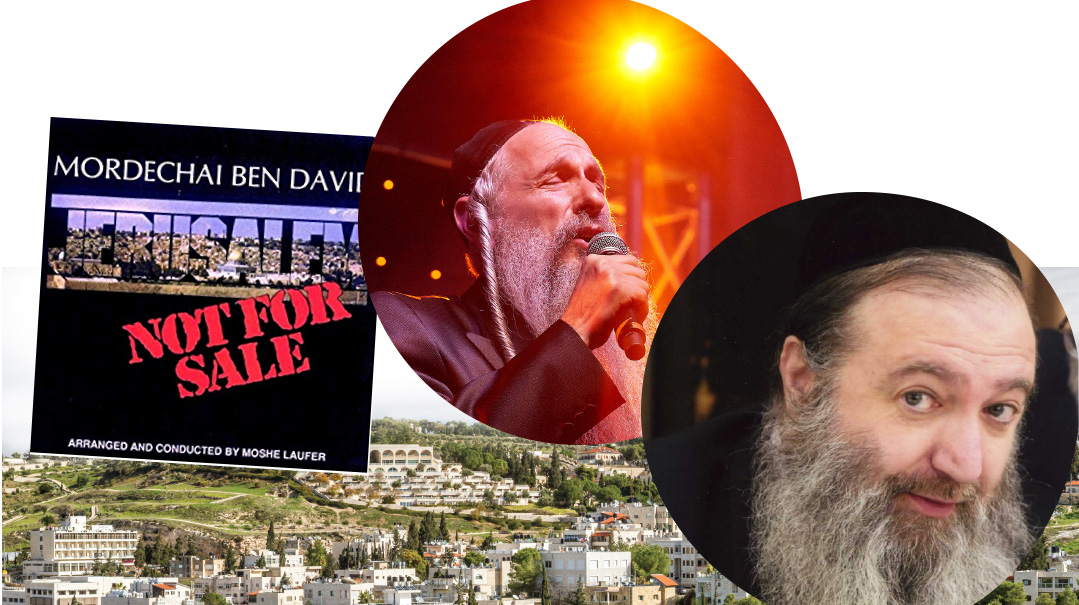
After two albums with title tracks about freeing Soviet Jewish Prisoners of Zion, Mordechai Ben David again jumped into the political fray with his refrain, “Yerushalayim is not for Sale” — an emotional appeal and warning to Mormon leaders who were seeking to build a grand campus on the foot of Har Hazeisim opposite the Temple Mount, and to then-Mayor Teddy Kollek, who agreed to give them a large chunk of prime property. References to previous enemies who had over the centuries failed in their bids to wage war on the holy city, and raw outrage at the perceived Mormon intentions of proselytizing, made this a passionate song of protest, and the candor of the refrain makes it into a slogan that has been borrowed at many and diverse protests. This song, with its calm introduction and confident chorus, conveys both the sanctity of our holy city, and its ultimate ownership by G-d alone. (In the end, the campus was built and remains a prominent fixture on Jerusalem’s eastern skyline, after the Mormon Church — which has generally been supportive of Jews and Israel — pledged that there would be no proselytizing or missionary work coming out of the campus.)
Chaim Miller, former deputy mayor of Jerusalem
I served as deputy mayor under Teddy Kollek, then under Ehud Olmert, and this Mormon scandal marred the end of Kollek’s term. Kollek had a majority in the city council without the chareidim, but he was the kind of politician who liked to build a wall-to-wall coalition, so the Agudah faction joined him. After all, from the opposition benches, all you can do is shout — from the coalition you can work to help your constituents.
Kollek was a master fundraiser, who managed to solicit monies from all over the world for projects in Jerusalem. For example, he completely rebuilt the municipal buildings using mega-donations from the Safra family, to create today’s Kikar Safra. The Mormons had given him vast donations, and they had asked him in return for land in the city to build a center for their faith. Kollek acceded and offered them a site on Har Hazeisim.
When the Lev Simchah of Gur heard about this deal, he was aghast and deeply pained. The Mormon mission is very dangerous. Mormons’ deep pockets would enable them to build an impressive, welcoming campus. Their famous Tabernacle choirs, hundreds of voices strong, would offer beautiful performances that would attract and ensnare vulnerable Jews, Russian immigrants, and curious students. That this should take form right opposite the Makom Hamikdash, enabled by a Jewish mayor, was an unthinkable outrage to the Rebbe.
Create a free account to keep reading.