Title:On Board the President Pierce
Location: Honolulu
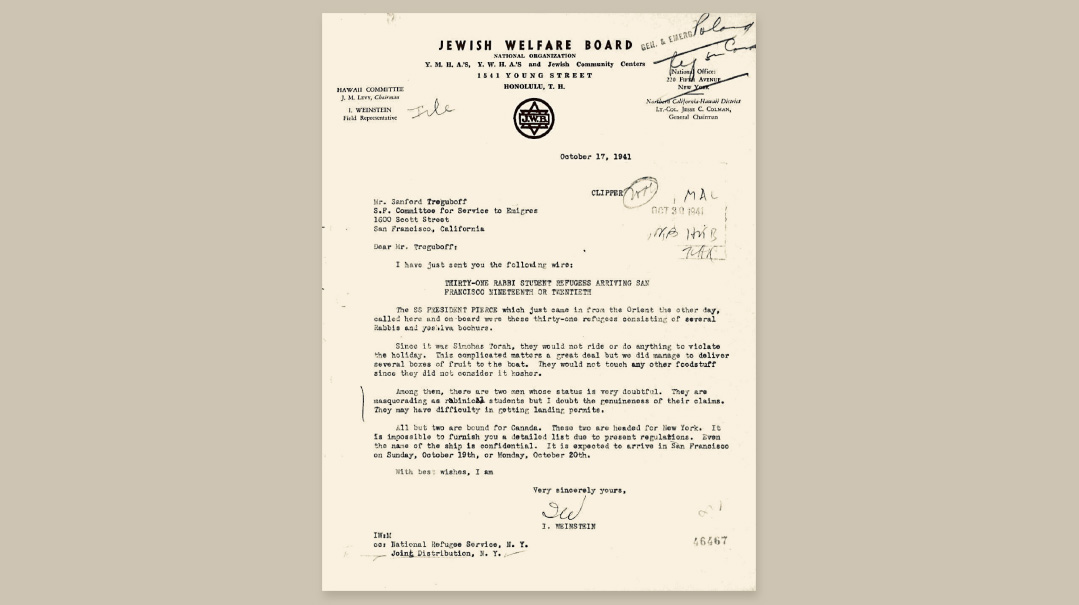
Document: Letter from the Northern California–Hawaii District of the Jewish Welfare Board
Time: October 1941
Shanghai, September 30, 1941
The American Joint Distribution Committee
100 East 42nd St., New York, N.Y.
Re: The group of 29 yeshivah men Canada bound who left by the S.S. President Pierce early this morning. (transit USA)
Dear Sirs …
The actual date of the departure of the S.S. President Pierce was made known only three days ago — i.e., that it was to leave on the eve of Yom Kippur. And it was then that the existence of two groups among the yeshivahmen became more apparent than ever.
Those of the Mirer yeshivah came to a unanimous decision not to go in view of the “2 Yom Kippur” and nothing could persuade them to change their minds. They are a united body with a firm ground — in view of the care taken of them by the American orthodox organization, thanks to which visas for Canada have been issued them and also transit visas from Washington, a thing almost unheard for up to now. They do not depend upon any of the local committees, receiving support and the required means direct from the States, and this explains their firm and independent attitude.
The other group are made up of members of other yeshivahs, such as Telsh, Kleck, Lubawicz, Lublin, Slobodko, etc. They are not a united body, do not receive direct support from American organizations, and exist on the support received from the Speelman committee (the usual budget to refugees) and occasional petty relief from the Committee for the Assistance of Jewish Immigrants from East Europe (“East Jewcom”). They are no less religious than those from Mirer yeshivah, but no special interest is taken in them (in comparison with the latter group). Their existence is by far not assured and they have eagerly seized the opportunity of leaving our city, deciding at the same time to keep two days Yom Kippur on the steamer.…
You will see from the enclosed list that among those who left were the widow and son of the well-known rabbi Chofetz-Chaim (Pupko-Kaplan) from Radin, a number of rabbis as well as students. All of them decided, as said above, to fast two days…
—The Far Eastern Jewish Central Information Bureau for Emigrants
IN the spring of 1941, Admiral Isoroku Yamamoto was authorized by the general staff of the Imperial Japanese Navy to begin operational planning for a massive attack on the US Naval Headquarters at Pearl Harbor. The success of the operation hinged on keeping it secret. To that end, the Japanese government had concerns about potential espionage among the throngs of foreign refugees temporarily housed on the Japanese home islands since the previous year.
Thousands of Jews fleeing Soviet-occupied Lithuania had received Japanese transit visas and had not been able to continue their journey to a final destination. The Japanese government decided to unceremoniously dump the refugees in Japanese-occupied Shanghai, China, until further notice. Upon arriving there in the summer and fall of 1941, most refugees had no illusions about a long-term arrangement of a Chinese sojourn, and they desperately sought routes to a final destination such as the United States.
After much wrangling, the Joint Distribution Committee was able to secure 41 visas for members of the yeshivah community among the refugees, as well as transport on the SS President Pierce, which was set to depart Shanghai for San Francisco at the end of September 1941. This would be a fateful journey; two months later, hostilities would break out between Japan and the United States, and there would be no trans-Pacific crossings for five years. The refugees who succeeded in departing on the President Pierce would be the last ones to leave Shanghai until after the war.
Although 12 members of the Mir Yeshivah received passage on the steamer, thereby ending their stay in Shanghai, they chose not to take this route. Their reasoning — as articulated by the leader of the group, Rav Leib Malin — was twofold.