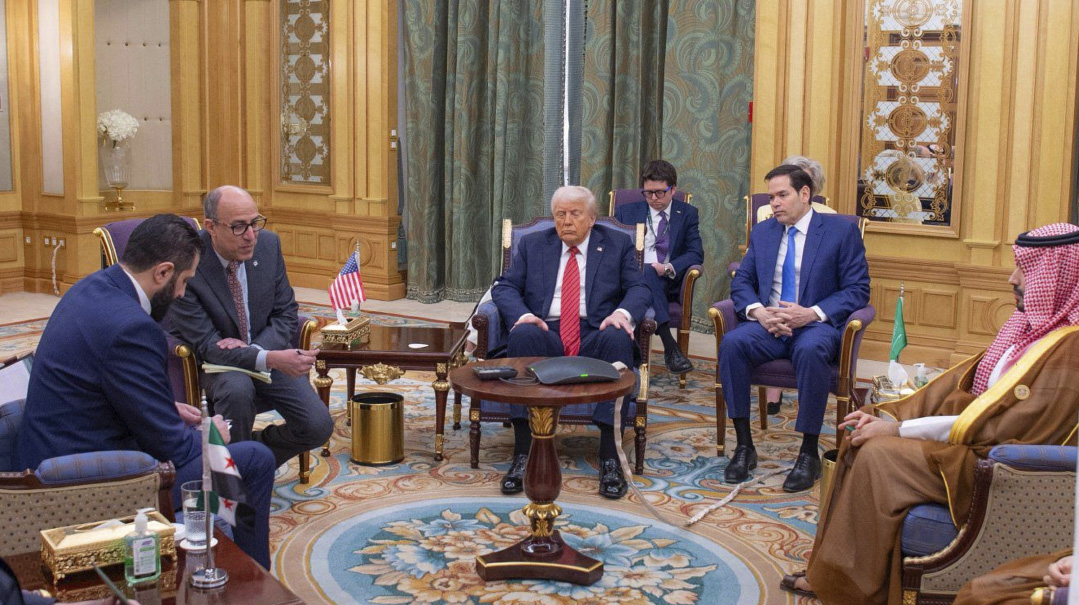
Following through on a promise he made several months ago, President Donald Trump has lifted a long list of economic sanctions on Syria, initially imposed on the regime of Bashar al-Assad.
When Ahmed al-Sharaa (formerly known by his nom-de-guerre Abu Mohammad Al-Julani) surprised the world by taking power this past January, most Western observers were happy to see Assad go but wary about the direction the long-plagued nation would take. Al-Sharaa’s radical Islamist militia, called Haayat Tahrir al-Sham (HTS), and its ties to al-Qaeda, did not inspire confidence. Yet steady signs of moderation have won Mr. al-Sharaa increasing international support.
The Trump administration’s decision to drop sanctions is a key piece in a larger game the president hopes to play in bringing greater stability to the troubled region. A key angle of this effort is expanding the Abraham Accords, establishing normalization between Syria and Israel, with other long-time foes like Lebanon potentially in the mix.
Ilan Berman, senior vice president of the American Foreign Policy Council, is certainly familiar with this territory. An expert in the Middle East and Russia, he has advised the multiple presidential administrations, Congressional committees, and the CIA.
Mr. Berman spoke with Mishpacha to share his views and expertise on what could lie ahead on this newly reconstructed Middle East diplomatic map.
Aside from the diplomatic signal sent by sanction relief, what practical impact does it have on the ground in Syria?
The sanctions were built up over the last 12 years or so to serve two purposes — limit Assad’s capabilities to brutalize his own people during the civil war, and isolate the regime economically by severing its links to the international financial system. Trump is trying the fix the latter part to incentivize this perceived political pivot and new moderation in Damascus.
There was a great deal of concern about Mr. al Sharaa and the jihadi past of HTS when he initially took power. Six months later, how do you evaluate his attempt to remake his image?
Time obviously will tell whether the new Syrian regime is earnestly committed to this path, but it’s clear, at least for now, that he’s picked pragmatism.
This is likely because al Sharaa’s main goal is to consolidate power and exert control over the entire country. That’s hard for him to do when his military is weak, when he doesn’t have foreign investment or international partners. He’s trying to demonstrate to the international community that Assad is gone and he, a former jihadist, has turned over a new leaf.
That said, it’s very early, and one can very easily imagine backsliding on the part of the new Syrian regime.