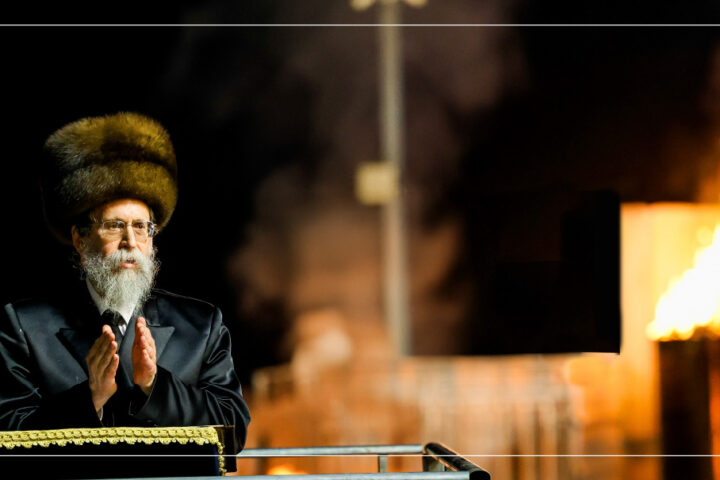
Rabbi Lamm helped masterfully affirm the centrality of religion in American life without veering into relativistic grounds of halakhic issues.
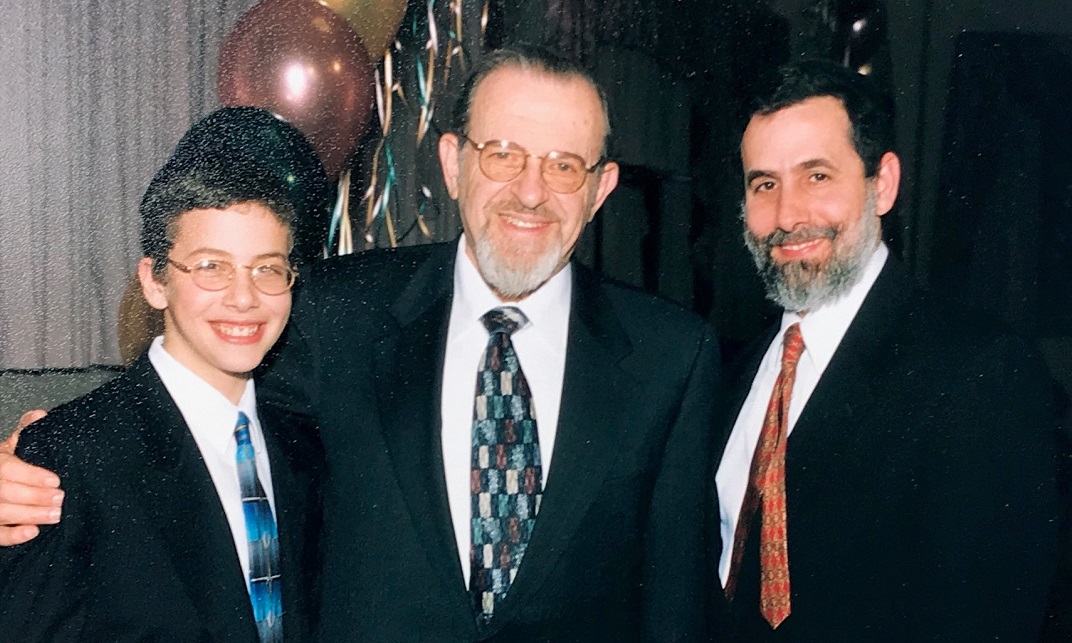
Rabbi Lamm (center) at the bar mitzvah of Rabbi Genack’s son Moshe, 20 years ago
R

abbi Dr. Norman Lamm ztz”l (1927–2020), was a towering figure whose influence cast a lasting legacy, a sterling example, and timeless ideas throughout the Jewish community. He began his career as a pulpit rabbi, after Rabbi Samuel Belkin (then president of Yeshiva University and a student of the Chofetz Chaim), convinced him to leave a promising future as a scientist.
In 1976, Rabbi Dr. Lamm succeeded Rabbi Belkin as the president of Yeshiva University. As a fellow student of Rabbi Soloveitchik, I always marveled at Rabbi Lamm’s capacity to be both a talmid and a leader. In fact, his capacity to hold opposites, embrace dialectics, lead with sensitivity and poise, and champion Torah values in a changing world marked his entire life’s work and career. He received his formative Torah education at Torah Vodaath and developed his own leadership at the helm of Yeshiva University. He contained multitudes and endowed them all will dignity and royalty.
In 1997, just before President Clinton’s second inaugural, I was invited to speak beside him at the opening ceremony of the second inauguration. It was a moving gesture and a testament to my long-standing friendship with President Clinton. The only issue, however, was that it was being held in a church and I knew I could not attend. There are few people who can help navigate such a dilemma. But I knew one such person, Rabbi Dr. Norman Lamm ztz”l. My response required delicate language, passionate commitment, and a sensitive approach to an esteemed friendship. Rabbi Lamm possessed all of those qualities and this incident highlighted so much of what made him such an extraordinary man.
Rabbi Lamm helped masterfully affirm the centrality of religion in American life without veering into relativistic grounds of halakhic issues. This story demonstrates his ability to respond to dignitaries because Rabbi Lamm himself possessed such an aristocratic quality. Rabbi Lamm’s Haggadah, which the OU published, was in fact called The Royal Table. In his introduction, he explains the dual nature of the shulchan melachim, the royal table in Jewish thought. In one respect, “the phrase was used to express contempt for this crude class-consciousness.” As we find in geirus, a convert is rejected if they are motivated by sitting at the shulchan melachim — converting simply for the financial gains that affiliation may provide. Pirkei Avos reminds us not to aspire to a shulchan melachim, but rather to the table of scholars. We also find that shulchan melachim, certainly in the context of Shlomo Hamelech, is the gold standard of excellence.
Create a free account to keep reading.