One surveying the Hungarian Orthodox scene on the eve of Kristallnacht would have seen the Chasam Sofer’s legacy everywhere
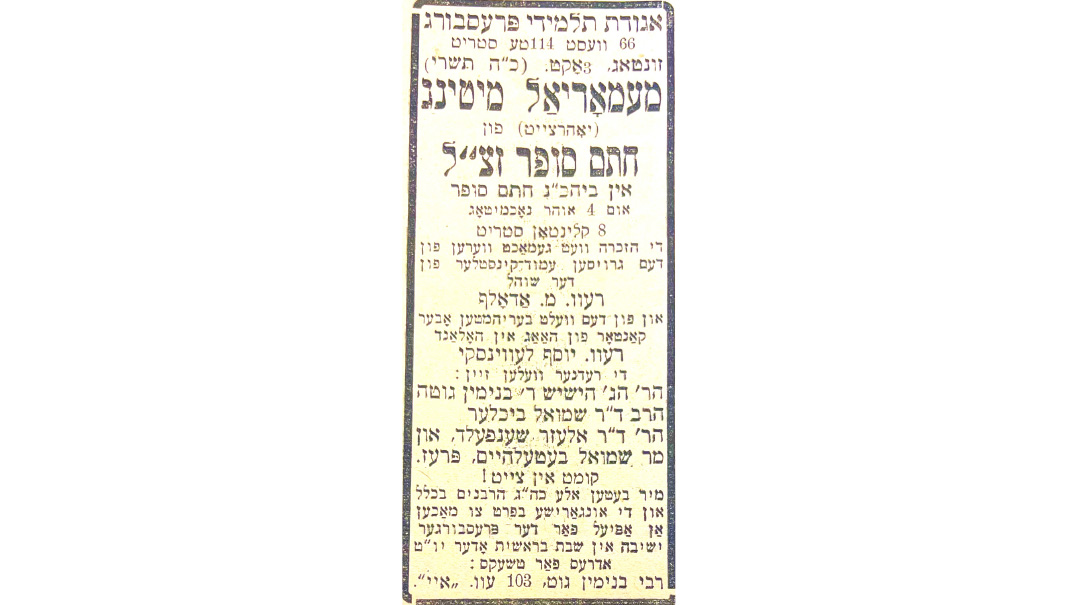
“We, our fathers and teachers, all of us are the product of one man. Moshe has spread forth through the generations! …And anyone who has engaged in [Talmudic] study here in Central Europe, if he is privileged, he will perceive that all streams emanate from the great sea — our mouths should be full of his praises — the author of the Chasam Sofer ztz”l.”
—Reb Shmuel Vizenberg, Kosice, Slovakia, 1938
One surveying the Hungarian Orthodox scene on the eve of Kristallnacht would have seen the Chasam Sofer’s legacy everywhere. Rabbis, yeshivos, communal norms, psak halachah, and the very survival of traditional Judaism itself could be attributed to his leadership and vision.
The awe and esteem in which the Jewish communities of the former Austro-Hungarian Empire held Rav Moshe Sofer, the Chasam Sofer (1762–1839), is almost unparalleled in modern Jewish history. Institutions and communities proudly carried his name, and his Torah was studied, his axioms were repeated, and his value systems were inculcated into subsequent generations. The masses of immigrants from those lands who reestablished themselves in the United States at the turn of the 20th century brought that veneration with them.
That veneration would have an ironic impact. In 1853, immigrant German Jews built a Reform synagogue at 8 Clinton Street on Manhattan’s Lower East Side, called Congregation Rodeph Sholom. It would be decades until the neighborhood hosted Jewish multitudes from Eastern Europe. The Reform congregation later journeyed uptown, eventually settling on the Upper West Side in 1930.
Create a free account to keep reading.