“Okay, so let me word it this way. If the rav feels he can’t come, can I offer the rav and rebbetzin tickets to Florida, really to anywhere, just so it doesn’t look bad? Maybe we can say your shvigger in Chicago isn’t feeling well? Whatever, just to take the edge off it.”
Barry Kosovitz wiped his mouth. “Goldie, these spareribs are something else, real oneg Yom Tov.”
“You worked hard tonight.” She grinned, “Actually, your children and eineklach worked hard. You sat back and enjoyed the hakafos like you’d paid for tickets.”
“Not exactly.” He grimaced slightly. “It wasn’t so enjoyable.”
He looked around, as if to make sure the children weren’t listening. They were, but he’d done his duty.
“Reb Hillel was… what can I say, it was like everything else. Embarrassing.”
He stopped to concentrate, spearing a piece of meat and adding a generous heap of mashed potatoes to his fork.
“For the sixth hakafah, like every other year, someone went to get all the children. It’s a tradition, you know, it’s a mesorah. Our own kids,” he looked around the table, “all grew up that way, whatever was going on, you came in for the sixth hakafah.”
He put down his fork. “Mesorah is everything,” he said, and then because he felt dramatic and oratorical, he said, “it’s what kept us all these years,” which was a very non-Barry thing to say.
The memories of the old rav filled the spacious dining room. Even the married sons remembered the exalted moment on Simchas Torah night when the rav would gather every single boy in the shul, and form a huge circle. The boys clasped hands and sang with enthusiasm, the tallis-draped rav dancing alone in the middle. Then, as they danced, the rav walked the perimeter of the circle, stroking the cheek of each boy, giving out brachos and candies. Mothers — and even some of the fathers — looked on with moist eyes.
But the rav was gone, two years now.
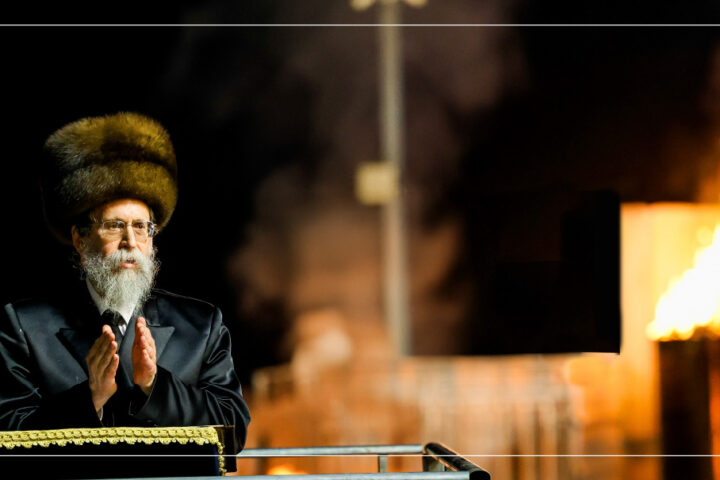
And tonight, when the gabbai hurried to gather the boys for the sixth hakafah, he had to remind the rav as well. The rav! Then, when the children were in place, the rav barely smiled at them. He took the hands of the two boys closest to him and held them limply for a few minutes, dancing in a tired circle, no passion, no brachos, no candies.
“Like he didn’t even care,” Barry said dolefully, and turned back to the spareribs.
To the rest of Brooklyn, Shaagas Aryeh had enjoyed the most seamless transition possible; a distinguished rav died and his distinguished son took over, no machlokes, no confusion about who would assume the post. The rav had several sons, but Hillel was the oldest and most qualified, and all the children supported the move. On the rav’s first yahrtzeit, the shul was fuller than it had ever been as Hillel — previously a respected posek in Lakewood — was appointed rav of Shaagas Aryeh.
The shul was still full every Shabbos, but it wasn’t the real deal. “It’s like a fruit bowl filled with fake fruit,” Heshy Nadler had said one day. “It looks great but there’s nothing there.”
It wasn’t that these men didn’t give Hillel a chance. They certainly encouraged him. They liked his halachah shiurim. They were happy when he spoke around the neighborhood. They even filled him in on some of his father’s minhagim. It seemed that once a week, Abie Nussen had to tell the new rav (whom he persisted in calling Reb Hilly, unable to get used to Hillel) what the old rav (he had to correct himself from saying “the real rav” every time) used to do.
“He’s been in Lakewood for so many years, how should he know what his father did?” Abie would tell his friends as they ate cheese delkelach and shared l’chayims after Shacharis.
The printer spat out a fresh sheet of paper; Hillel lifted it gingerly.
NEW SCHEDULE OF WINTER SHIURIM. He knew which ones would draw an audience and which would mean him sitting alone with old Mr. Hedman, who came to all of them.
The Maharal shiur would be full, he knew. He would speak and people would come over after and compliment him. “Amazing shiur,” Joe Neulander would say, and Rabbi Young would be taking notes. Still, as Hillel taped the sign to the door of the empty shul, he couldn’t shake the unsettling feeling that it was all fake. He made a difference to absolutely no one in the shul. It wasn’t that they disliked him; they liked him okay. They tolerated his shiurim and speeches. They found him adequate. They had no complaints.
“That would be fine if I was their barber or plumber, but I’m their rav; they should care,” he told Elisheva. “When I told Shragi Marcus that we’re going out of town and I would have to miss his siyum haShas, he shrugged and told me he understood.”
At the monthly Vaad Hakashrus meeting, Mordechai Bernstein teased him, “How’s the crown prince of Flatbush?”
Mordechai was a successful rav too, but as he liked to say, he’d worked to get there. He’d been a rav in Buffalo and then in Rochester before getting a position in Brooklyn. The insinuation was that Hillel’s father had left him a bed of roses — great shul, well-mannered members, no politics.
They sat there drinking coffee and Mordechai confided in him about a rough situation he was having. He’d spoken from the pulpit against eating at a certain establishment, and many of the members were upset with him; they felt he should have done more research, spoken with the owner for longer, that he was being small-minded and making Yiddishkeit about bugs in lettuce instead of “real” issues.
Hillel nodded in sympathy, but he felt a strange sense of jealousy as well. Mordechai had the power to anger his congregants with his positions. If Hillel would speak against eating somewhere, they would come over and say “nice speech, shkoyach,” and file out of shul happily. If he would get up and say that no one should use microwave ovens or eat fleishigs or drive a car, they would nod politely and move on. No one would get angry.
Create a free account to keep reading.