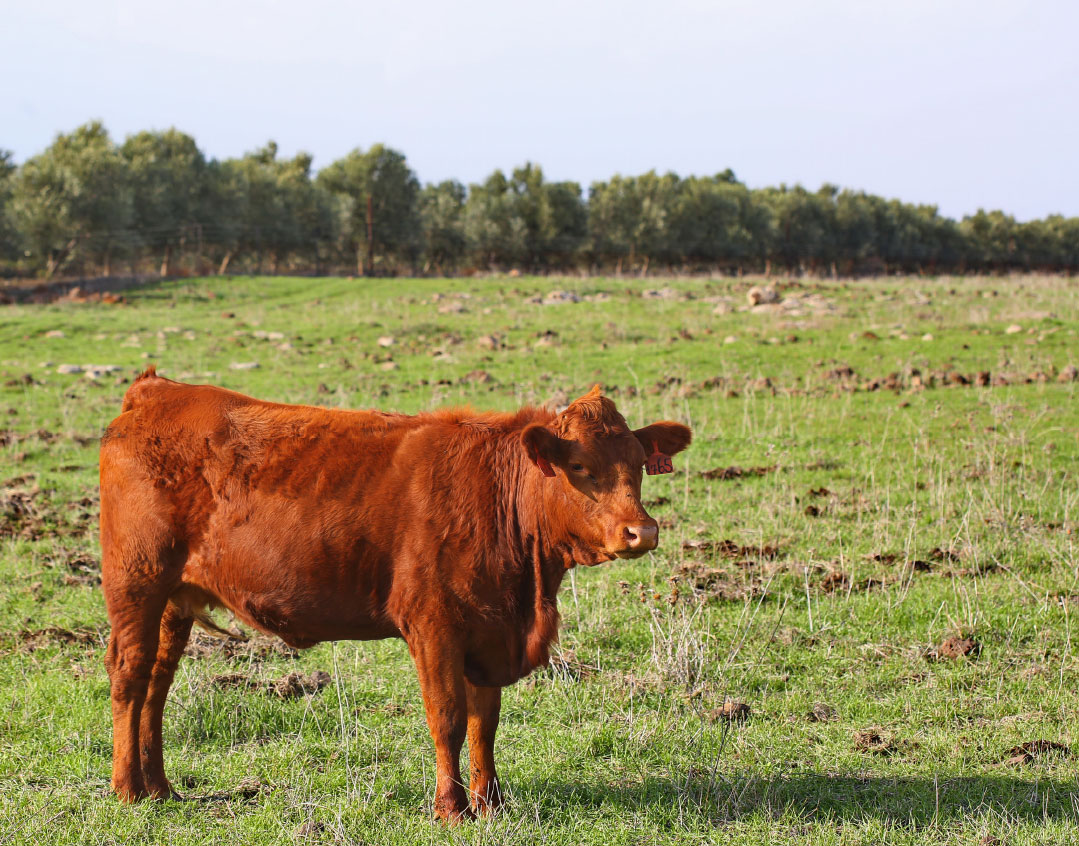
On a cattle ranch somewhere in the Golan, a red calf has been born that may have an impact on the future of the entire Jewish people. Is it possible that this Red Angus cow, now over a year old and still unblemished, will be the tenth and final parah adumah?

W
hile the weeks leading up to Pesach don’t automatically make people think of vacations,the Golan Heights actually attracts thousands of visitors at this time of year, after the winter rains have replenished the earth and the lush green foliage and multi-colored flora take bloom. But we were in the region to look out for another burst of color — we wanted to meet the cattle rancher who’s taken on raising what he hopes might be the next red heifer.
He’s happy to host us, as long as we don’t reveal his name or the exact location of his ranch up here in Israeli cattle country. “Things are already getting complicated for me,” he says. “In this situation, discretion is more important than anything else.”
As we drive to the outskirts of the ranch on his tractor, Mr. Cattleman, as we’ll call him, fills us in on how he landed in this position. He’s been herding cattle here for close to 50 years, as one of the Golan Heights’ pioneer settlers after the region was liberated from Syria in the 1967 Six Day War. He grew up on the religious moshav of Beit Chilkiya in the center of the country, but the challenge of the northern heights pulled him. “I raise 200 head of cattle here on 5,000 dunams,” he says.
Mr. Cattleman primarily raises Simmental cattle, a popular breed in Israel. But a few years ago, he was contacted by the staff of the Machon Hamikdash in Jerusalem, an institute dedicated to raising public awareness of the mitzvos related to the Beis Hamikdash. The men from the institute made him an offer that he couldn’t refuse. “They wanted me to raise an additional breed of cattle — Red Angus cows,” he says. “Their goal was to try to produce a perfect Parah Adumah which would meet all the halachic criteria.
Create a free account to keep reading.