“Jewish history as a discipline and Jewish history books in general did not come into vogue until the late nineteenth century”
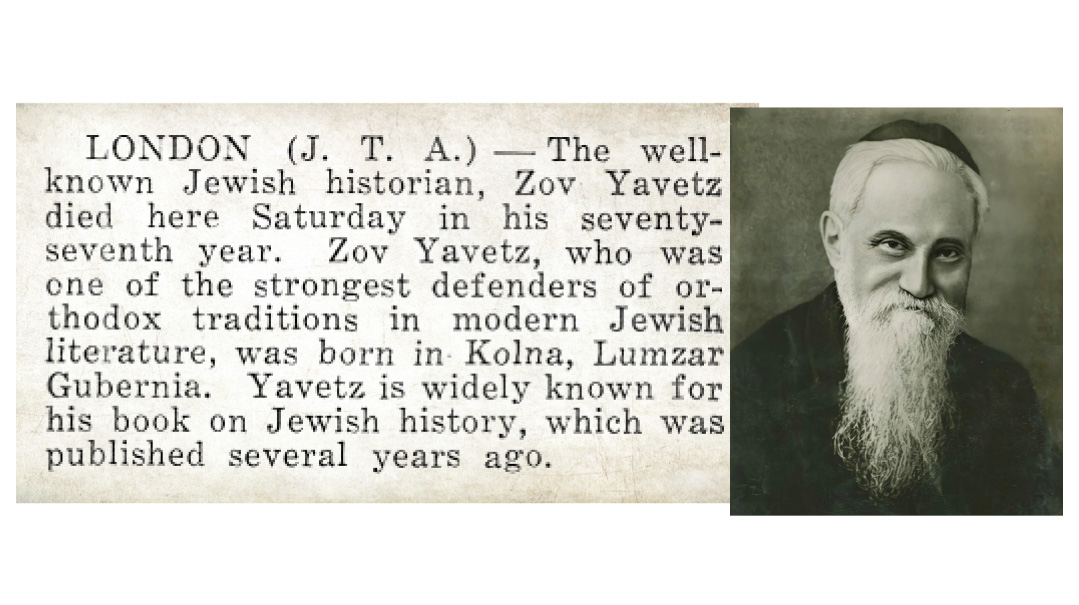
It has truly been noted that history is too important to be left to the historians. This is certainly true in the case of Jewish history. Jewish history as a discipline and Jewish history books in general did not come into vogue until the late nineteenth century. Jewish historiography, therefore, has been almost exclusively the product of secular Jews (the main exception being the fourteen-volume series on Jewish history by Ze’ev Yavetz, first published in the 1890s), who held a strong bias against rabbinical Torah Judaism. Thus, the irony of most Jewish history texts is that they have been written with condescension, if not hostility, to the basic beliefs and true heroes of Jewry over the centuries.
—Rabbi Berel Wein, introduction to Triumph of Survival: The Story of the Jews in the Modern Era 1650–1995
Jewish historiography experienced a rebirth in the modern era. The Wissenschaft des Judentums (“science of Judaism”) movement in 19th-century Germany was the first to generate modern interest in researching Jewish history. This culminated in the 11-volume work of Heinrich Graetz (1817–1891) entitled History of the Jews. Though it achieved renown in academic circles, it received considerable criticism in religious circles for its nontraditional approach and its disregard for the religious perspective and the correct use of Jewish sources.
More Jewish historians would emerge over the course of the 19th and early 20th centuries. Most of these scholars were, like Graetz, initially Torah observant, but had abandoned their religious beliefs, and the way they rendered Jewish history often reflected that bias. The preeminent Jewish historian of the 20th century was likely Simon Dubnow (1860–1941). His contribution to Jewish historical research included his magnum opus ten-volume World History of the Jewish People, but it also lacked a religious orientation.
Create a free account to keep reading.