This Thursday, the 16th of Teves, marks the 23rd yahrtzeit of Rav Chaim Kreiswirth
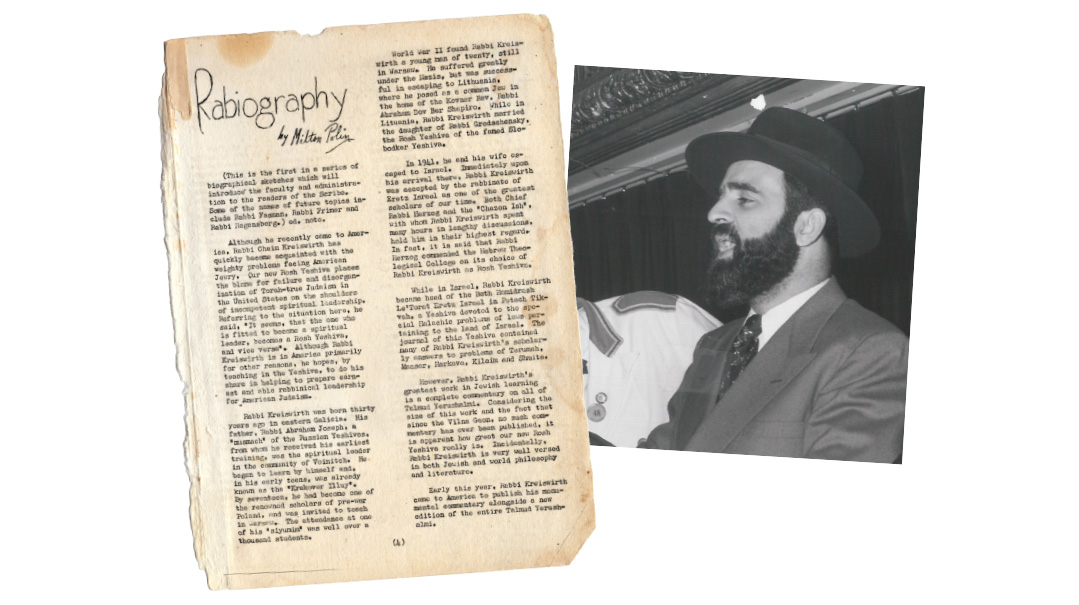
Born in 1920 in Wojnicz, Poland, Rav Chaim Kreiswirth grew up in a distinguished Galician rabbinic family. His father, Rav Avraham Yosef, served as the town’s rav, and young Chaim was immersed in Torah scholarship from an early age. By his teens, he was a prized student at the prestigious Yeshivas Chachmei Lublin, where his brilliance turned heads. At the age of just 18, he was already teaching Torah in Warsaw, a prodigy destined for greatness.
With the outbreak of war, Rav Chaim fled to Vilna, where his reputation as “the Krakover Illui” began to spread. The nickname, though geographically inaccurate — he had never lived in Krakow — became synonymous with his towering intellect and sharp analytical mind. Tragically, his parents and four siblings remained behind in Poland, where they were murdered in the Treblinka gas chambers. Rav Chaim was the sole survivor, carrying the weight of their memory as he forged ahead.
In Vilna, the young Polish genius caught the attention of Torah giants. Rav Chaim Ozer Grodzenski, Rav Chanoch Henoch Eiges (the Marcheshes), and the Devar Avraham of Kovno were astonished by his encyclopedic knowledge and refreshing humility. Rav Chaim wasn’t merely a scholar; he was a delight to engage in Torah conversation, a Galicianer who could stand toe-to-toe with the greatest minds of Lithuania.
One such admirer was Rav Avraham Grodzinski, the Mashgiach of Slabodka Yeshivah, who considered Rav Chaim a potential match for his daughter Sarah. Before proceeding with the shidduch, Rav Avraham sought the counsel of the Devar Avraham. The Kovno Rav’s endorsement was effusive: “In addition to being an illui, Chaim is also a baal middos.”
His proof was characteristically incisive. “I recently sent him divrei Torah,” the Devar Avraham explained, “and instead of finding flaws or tearing the chiddush apart — as is the custom of many lamdanim — he added several proofs to strengthen it. This young illui takes pride in the divrei Torah and chiddushim of others, a middah as rare as it is precious.”
The young couple married and miraculously made it to Eretz Yisrael shortly thereafter. Her father and most of her siblings were murdered by the Nazis and their Lithuanian collaborators in the Kovno Ghetto, though some of her siblings survived and made it to Israel after the war.
In 1947 he was hired as the rosh yeshivah of Hebrew Theological College–Beis HaMidrash L’Torah in Chicago, which was experiencing a golden age. For next seven years, Rav Kreiswirth, with his Torah genius and magnetic personality, raised a generation of talmidim, many of whom became prominent rabbinical figures and Torah teachers in the decades to come.
Rav Kreiswirth’s impact in Chicago is best captured by one of his closest students of that era, Rabbi Berel Wein, who recalled those years with obvious nostalgia:
In 1954 the Machzikei Hadass community of Antwerp was seeking to fill the rabbinical position, which had remained vacant since the martyrdom of Rav Mordechai Rottenberg in the Holocaust a decade earlier. Upon the recommendation of Rav Shmuel Greineman and Rav Yaakov Kamenetsky (who was Rav Kreiswirth’s uncle through marriage, as Rav Yaakov and Rav Avraham Grodzinski had married sisters), they invited Rav Kreiswirth to fill the position.
Rav Kreiswirth visited the community, saw great potential in spreading Torah and Yiddishkeit in Antwerp, and was strongly considering accepting the invitation. When his students at the yeshivah in Chicago found out, they were horrified, and quickly penned a sharply worded letter to the overseers of the Antwerp community, imploring them not to take their beloved rebbi away from Chicago.
To no avail. Rav Chaim Kreiswirth moved to Belgium, and remained the rav of Machzikei Hadass Antwerp until his passing 48 years later in 2001.
He never rested on his laurels in Antwerp, however. He continued to visit the United States on an almost annual basis, connecting with former talmidim and guiding them, and sometimes spurring them to further their careers in harbatzas Torah.
He also invested time and resources in building Torah infrastructure in Israel, eventually residing part time in Jerusalem’s Har Nof neighborhood in his later years. Through his close student Rav Aryeh Rottman, he was involved in the establishment and growth of the Mercaz HaTorah yeshivah in Talpiot.
In Har Nof, he was sometimes seen having animated Torah discussions with Rav Ovadiah Yosef, the two great Torah geniuses citing long passages from Shas, Rishonim, and poskim by heart to each other. Rav Benzion Abba Shaul related to his students that he only recited the blessing of shechalak mei’chochmaso, which is recited only on the greatest of Torah sages, on three individuals — the Steipler, the Satmar Rav, and Rav Chaim Kreiswirth.
During his sojourn in Jerusalem, Rav Chaim Kreiswirth resumed his ways of developing close relationships with leading Torah scholars of the city, who in turn were amazed at his vast knowledge.
A story is told from that period of a conversation he had with Rav Isser Zalman Meltzer and the Mirrer rosh yeshivah, Rav Leizer Yudel Finkel, both decades his senior. Rav Kreiswirth mentioned that a certain Tosafos was a “pele” — although in the course of the conversation, Rav Kreiswirth had cited that Tosafos and many others verbatim as was his custom. Rav Leizer Yudel interjected, “The Tosafos isn’t a pele. The fact that you’re quoting everything by heart is a pele!”
One of Rav Kreiswirth’s many objectives in his travels was his dedication to supporting the poor, orphans, widows, and other unfortunate individuals. His personal fundraising for thousands of impoverished families and individuals occupied much of his time. He was once asked why he never recorded memoirs of his experiences with the great Torah personalities he was privileged to be acquainted with in his youth. He emphatically replied that he preferred to utilize the time it would take to write those stories to further fundraising efforts on behalf of additional widows and orphans.
(Originally featured in Mishpacha, Issue 1045)