Most of the information we have for him comes from oral traditions among Unterland Hungarian Jewry
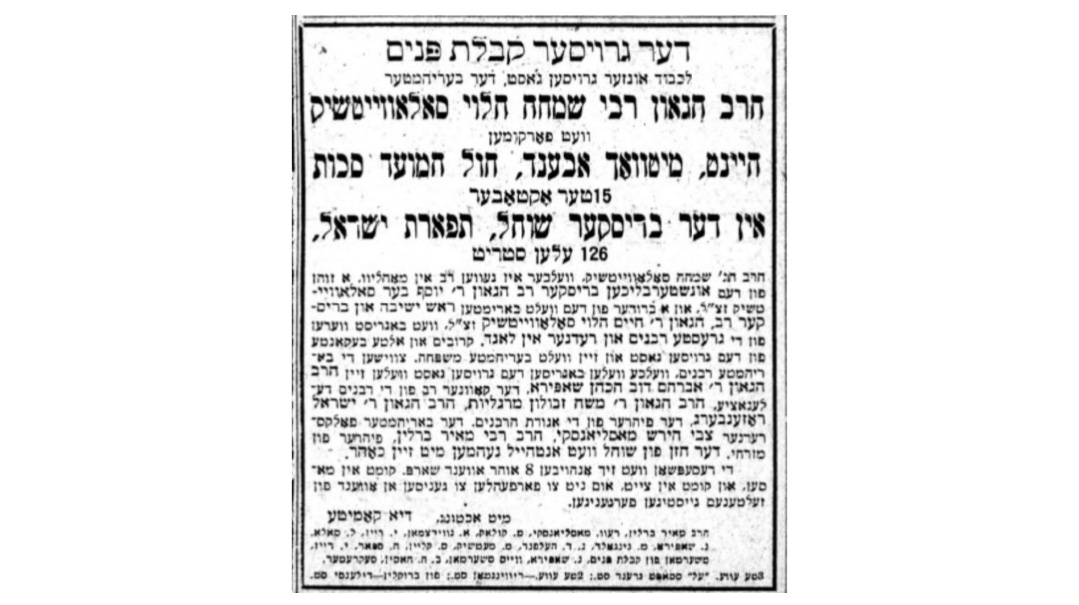
The Jewish People has been blessed with many Torah giants whose leadership was felt in their own lifetimes and whose well-known accomplishments still resonate to this day. There have been other leaders, however, who didn’t have the same sort of noisy impact. Such was the leadership of one of the most unique leaders in Jewish history — Rav Shayale Steiner (1851–1925) of Kerestir, Hungary.
Born of humble lineage, he emerged as the personal attendant of Rav Tzvi Hirsh Friedman of Liska. He was later a follower of the venerated Divrei Chaim of Sanz and then Rav Mordechai Leifer, known as Rav Mottele of Nadvorna, who advised him to move to the eastern Hungarian town of Kerestir (Bodrogkeresztúr), nestled in the quaint Tokaj wine region.
Upon assuming the unlikely mantle of chassidic leadership, Rav Shayale soon emerged as a rather unconventional chassidic leader for his era. He authored no seforim, didn’t serve at the helm of any institution, did not deliver a formal shiur, nor did he even share his own Torah in the traditional sense at his Friday night tish. He didn’t associate with any Orthodox political party of his day, did not attend conventions, nor did he deliver speeches. He took no public stance on Zionism, moving to Eretz Yisrael, or on any other hot topics of that period.
So what did he do? As he himself put it, he fed hungry Yidden who came to his door. Lacking any institutional framework or charismatic public persona, Rav Shayale was a fatherly figure filling basic physical needs for the poor, the downtrodden, and anyone who needed a shoulder to cry on. Word spread around Hungary that there was a rebbe in Tokaj who simply cared about others.
Create a free account to keep reading.