In his gentle yet forceful way the honorable President Rosenthal stirred the hearts of our Jewish brethren to donate money to purchase a permanent home for the Talmud Torah
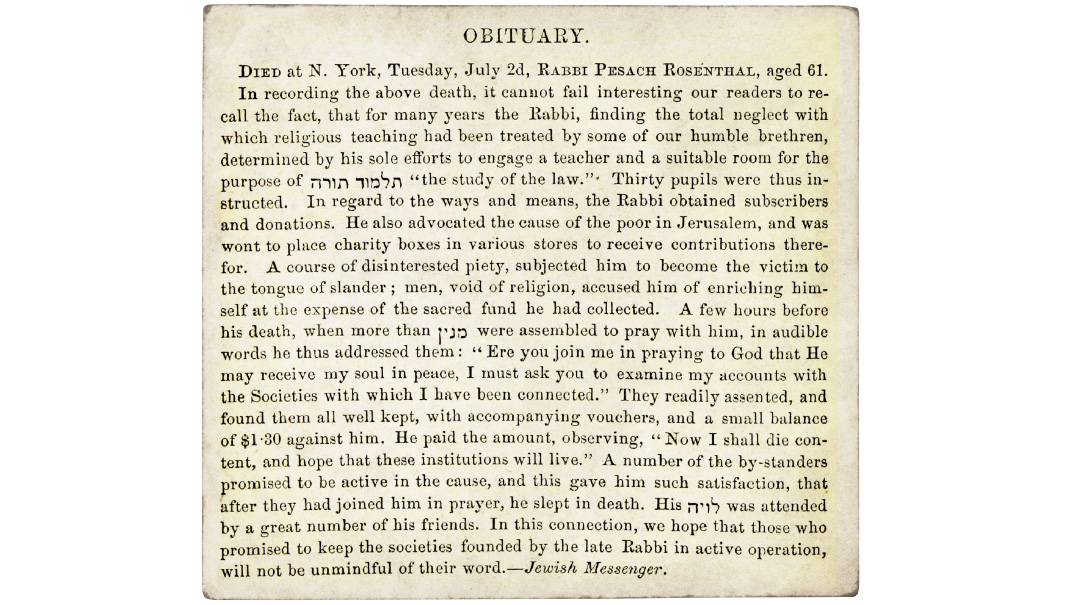
Rabbi Pesach Rosenthal, a forgotten pioneer of 19th-century American Orthodoxy, immigrated from Poland in 1846. He served the Jewish community in Utica, New York, impressing Rabbi Isaac Leeser with his devotion during a visit in 1851.
Here, too, we met with a congregation having a place of worship, which, however, we regretted not finding in as good order as it should be. It is situated in Hotel Street, and is a wooden structure, and a little expense judiciously applied would render it as well-looking as the Beth-El at Albany. We hope that this will be speedily attended to. The minister is a learned Polish Rabbi, who wears the national costume. His name is Rabbi Pesach Rosenthal, and he officiates as Hazan, Preacher, and Shocket, and attends other duties besides. He is an illustration of the peculiar devotedness of the Jewish teacher to his calling, not rarely met within countries where the yoke of oppression weighs heavily upon us.
In Utica, Rabbi Rosenthal instituted an annual collection for the chalukah in the Land of Israel. He initiated that project following a fundraising visit by Rabbi Aaron Zelig Ashkenazi, a representative of Jerusalem’s Perushim community who passed through Utica en route to the Midwest in 1850. Rabbi Ashkenazi kept a detailed ledger of the donations he raised, and it lists the names 17 Jews in Utica who constributed, along with their greetings and notes in both Hebrew and Yiddish to friends in Palestine.
After about a decade in Utica, Rabbi Rosenthal moved to New York City, where Polish Jews were beginning to settle. He took the helm of Beth Hamedrash Hagadol, the first “Russian” Jewish congregation, which had been organized in 1852 on the Lower East Side in a “garret” of 83 Bayard Street. Judah David Eisenstein, who arrived in 1872, recalled that in the shul’s beis medrash one could “find Jews engaged in study…. It has many books, as in the great House of Study in Poland.”
Create a free account to keep reading.