It wasn’t a new item of clothing or a hard-to-obtain food item that he coveted; rather, it was a list of seforim
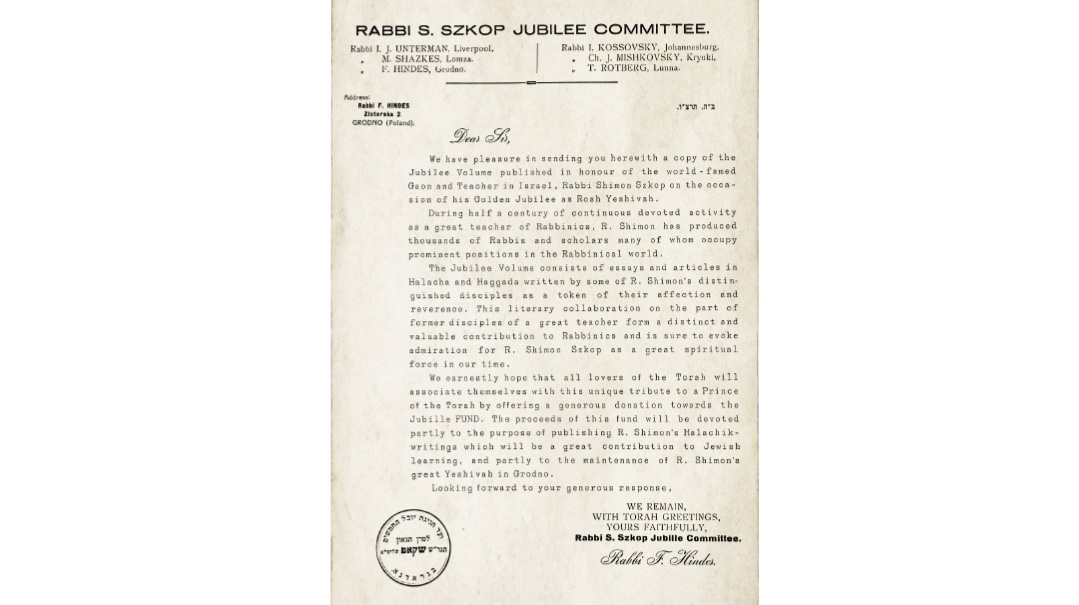
IN 1937, a 23-year-old yeshivah student in Montreux, Switzerland, named Aharon Leib Steinman wrote home to his parents in Brisk, Poland, with a request regarding their upcoming visit. It wasn’t a new item of clothing or a hard-to-obtain food item that he coveted; rather, it was a list of seforim, among them a newly released title unavailable in the picturesque Swiss resort town—the Sefer HaYovel (“Jubilee Book”) written as a tribute to the great Grodno rosh yeshivah, Rav Shimon Shkop, celebrating 50 years of his teaching Torah.
Though such books were common in academic circles, they were novel in Torah society. The compilers envisioned the sefer Yovel on Rav Shkop as a fundraising and publicity vehicle to alleviate the Grodno yeshivah’s desperate financial situation.
The very idea of publishing a sefer Yovel in honor of a live rosh yeshivah generated some controversy. Rav Elchonon Wasserman —a talmid of Rav Shimon Shkop from his days in the Telz yeshivah — questioned the idea. Rav Elchonon refused to submit an entry, citing the fact that jubilee books (known by the German term “Festschriften”) were “not a Jewish custom.” However, the project proceeded with the support of Rav Elchonon’s brother-in-law, Rav Chaim Ozer Grodzenski, who cited the publication’s value as a fundraiser for the Shaar HaTorah yeshivah headed by Rav Shimon in Grodno.
As I surely know and recognize this pure and gentle soul, and the modesty of his righteousness, he will feel uncomfortable and the praise before him will be a strain, as well as the issue of the Jubilee, which is not the custom of our elder rabbis — but Rav Shimon has strained me, the strain of the holy work of bearing the burden of the yeshivah, so he must forgive this and bear this burden as well, due to its purpose: the issue of finding relief for the yeshivah, to lighten its heavy load and the onus of debt hanging over it, which will guide him to rest…
Create a free account to keep reading.