As the sun set, the Graf Zeppelin headed to Jerusalem, where its arrival coincided with Shushan Purim celebrations
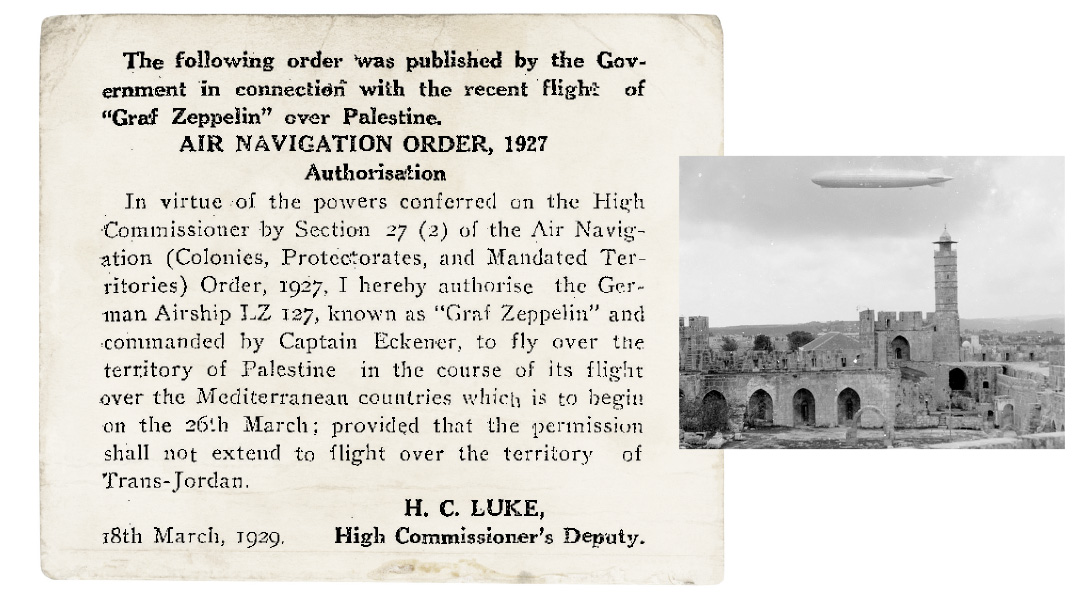
IN July 1900, two and a half years before the Wright brothers’ historic flight in Kitty Hawk, North Carolina, Count Ferdinand von Zeppelin successfully piloted a lighter-than-air rigid airship over Germany’s southern Rhine River Valley. Though dirigible development would eventually give way to airplanes, von Zeppelin’s lighter-than-air rigid airships controlled the skies during their golden age in the early decades of the 20th century.
Von Zeppelin’s success made Germany the world leader in the emerging rigid airship industry, and the aircraft he pioneered soon assumed the name of their inventor. By 1910, the first commercial airline in the world, Deutsche Luftschiffahrts AG, or DELAG, began operating a fleet of seven zeppelins.
Soon Great Britain, France, and the United States began building their own zeppelins, primarily for military use, but also with an eye toward commercial use. During World War I, the Zeppelin Company constructed nearly 100 military airships for the German Navy, some of which were deployed in the first aerial bombings in history in 1915, against Britain.
The years after World War I saw heavy international investment in the zeppelin industry, though the Treaty of Versailles prohibited Germany from manufacturing large airships. When the treaty was relaxed somewhat in 1925, the Zeppelin Company immediately embarked on the construction of a new class of airships, inaugurating the golden age of zeppelins. The craft made hundreds of nonstop transatlantic flights, primarily between Germany and Brazil, decades before any airplane accomplished the same feat.
Create a free account to keep reading.