See water “walk” in this incredible experiment!
Photos: Yochanan Ghoori
You’ll see the colors from each cup travel up and down the paper towels, filling empty cups and mixing into new colors.
You will need:
7 clear plastic or glass cups
Water (about 7 cups)
Food coloring
(3 colors: red, yellow, and blue)
6 paper towels
Scissors, if necessary
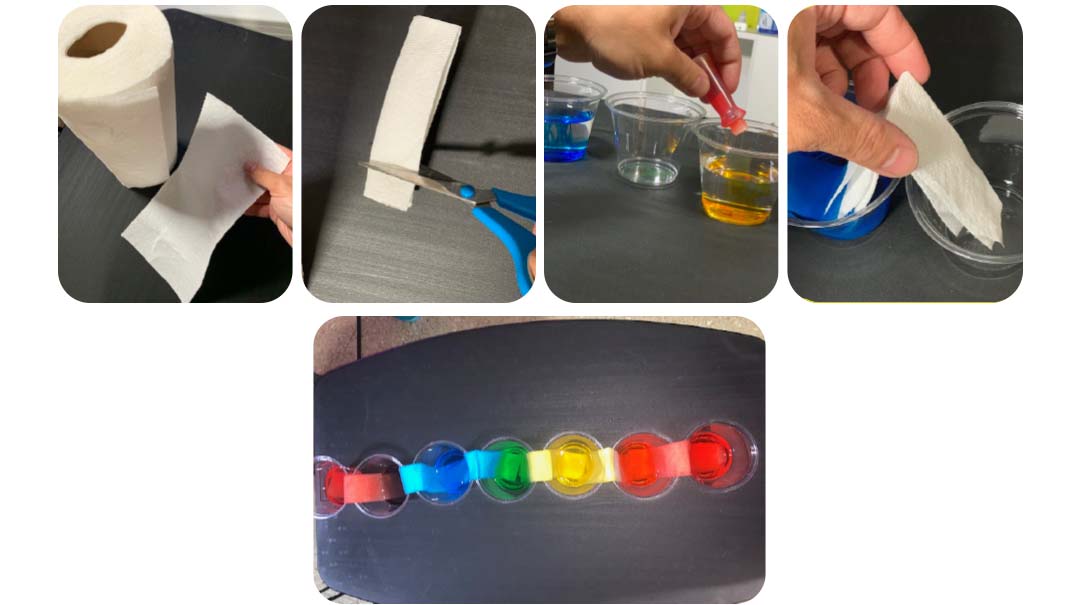
How to do it:
Cup 1: Red water
Cup 2: Empty
Cup 3: Blue water
Cup 4: Empty
Cup 5: Yellow water
Cup 6: Empty
Cup 7: Red water
Voila! Walking rainbow water!
The water travels up the fibers in the paper towels through a process called capillary action, which we’ve discussed here before. Capillary action is when liquids move upward through a solid. The water is also showing properties of adhesion. That’s when dissimilar particles stick together. In our case, that’s water sticking to the paper towel — and not letting go. The experiment is also demonstrating cohesion. That’s when similar particles stick together (in this experiment, that’s water sticking to water). The water molecules stick to each other as the water climbs up and over the mountain.
Want to see more of how temperature affects expansion and contraction of molecules? Put some hot water in one jar and some ice water in another. Then drop some food coloring into each jar. Watch as the food coloring falls through the water. How did the water temperature affect it?
Did you know
Don’t ever take the ability to see colors for granted! Seeing colors is actually a tremendous brachah, as many people are born without the ability to see some colors. There are different types of color blindness, and they affect how people see and perceive different colors.
Create a free account to keep reading.