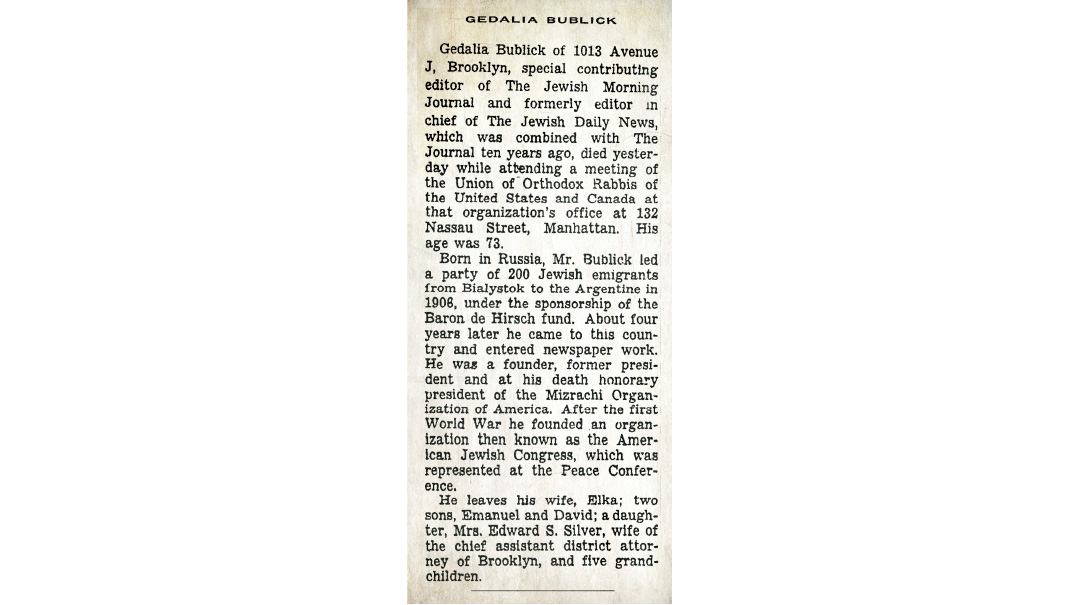
Who was this editor in chief of Yiddishe Tageblatt?
Harvard or Volozhin? Our Yiddishe Torah, for which generations of Jews have happily given their lives, has been exchanged in this country for the culture of our neighbors… We’re supposed to go to shul and proudly recite the brachah of “asher bachar banu mikal am, venasan lanu Toras emes (Who chose us from all nations and gave His Torah of truth).” However, we believe that the “Torah” of Harvard is greater than the Torah of Volozhin. We’re happy that our children study in Yale and not in Mir Yeshiva.
—Gedaliah Bublick, Min Hameytsar,
Like the prophets of old, Gedaliah Bublick used his pen to issue a clarion call to the immigrant generation of American Jewry, beseeching them to invest in education, maintain their tradition, and beware the dangers of assimilation. Who was this editor in chief of Yiddishe Tageblatt? And how did he emerge as a leading advocate for Orthodoxy, while vociferously opposing acculturation and watered-down versions of Judaism across the American landscape?
Born in Grodno in 1875 and raised in Bialystok, Gedaliah Bublick studied in the Lomza and Mir yeshivos before drifting away from Torah observance, as was common for the youth of his day. Following stints in Paris and Argentina, in 1904 he immigrated to the United States, where he embarked on a career in journalism. As an astute observer of “huddled masses” attempting to fit in, he soon concluded that millions of Jewish immigrant children were staring into the abyss of losing their Jewish identity.
Bublick personally returned to Torah observance and began wielding his pen to call for changes in general approach to Yiddishkeit on American shores. Decades ahead of his time, he warned of the dangers of diluted religious observance like that found in the nascent Conservative movement (still nominally Orthodox during the 1920s), and predicted mass intermarriage across wide swaths of American Jewry in coming decades.
Create a free account to keep reading.