These mom-and-pop shops still do brisk business sans clicks, swipes, or apps
In an era of sprawling malls, glossy franchises, and online giants promising delivery at the click of a button, you’ll still find them: the corner pharmacy with the hand-lettered sign, the pizza shop where nothing’s changed but the price of a slice, the diner that’s serving the same breakfast since Kennedy was president. Against the odds, these mom-and-pop shops have endured, holding their ground as living reminders that commerce can still feel like community.
Which of these stores remind you of less frenetic days?
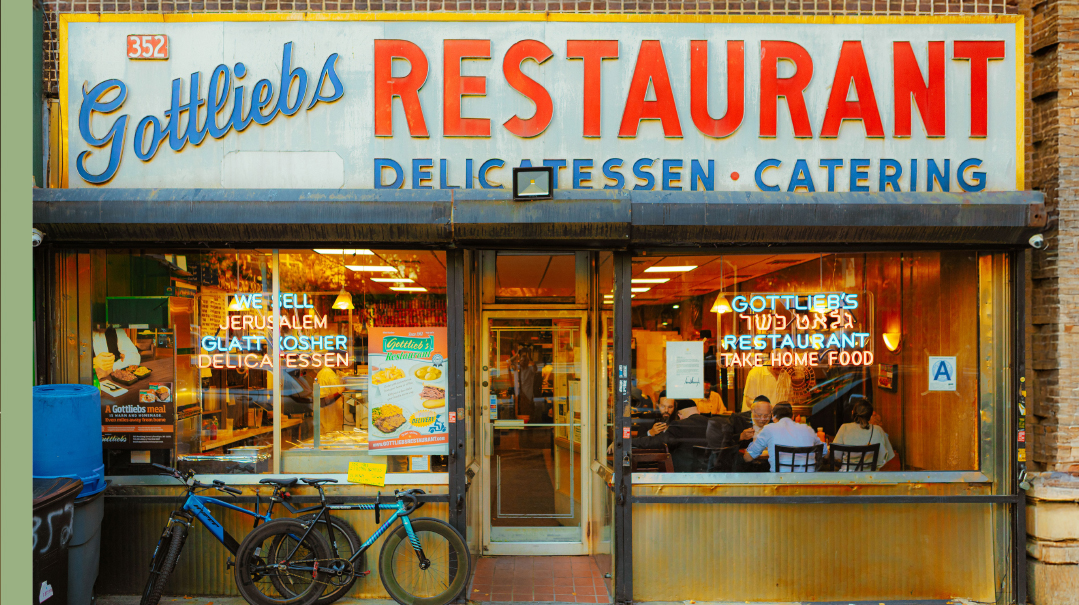
Gottlieb’s Restaurant on Roebling Street in Williamsburg looks exactly like the deli you picture when someone says “old-school.” The faded sign out front, the glowing neon letters assuring glatt kosher comfort, the shelves on the wall piled with disposable containers and the no-frills menu chart are all part of the charm. Inside, the deli case is piled high with kugel, knishes, latkes and cold cuts.
The deli was opened in 1962 by Shloime Zelka Gottlieb, grandfather of current owner Menashe Gottlieb. When the store opened, it was a novelty — it wasn’t common for chassidish families in Williamsburg to eat out, but Reb Shloime had a broader vision: He provided a place where people who didn’t have easy access to heimish food could gather to eat, often for free.
“The store was always intended to be like second home, a place to farbreng, schmooze, and meet people,” says Menashe. Widowers and Holocaust survivors with no families would line up for Mr. Gottlieb’s dishes. “He was always cooking food for people,” says Menashe about his Zeide. “After the war, in the DP camps, he was somehow always feeding people.” Opening a brick-and-mortar deli in Williamsburg was the natural next step.
The Gottlieb family has run the deli ever since. “My father, Shulem Yosef, joined the business in the late ‘60s, shortly after his chasunah,” says Menashe, who followed about 25 years ago. Shulem Yosef became a Williamsburg fixture, his name synonymous with the diner and with good old-fashioned Hungarian food, until his sudden petirah last year at age 75.
Over the years, a who’s who of New York rabbanim walked through these doors. “Back before my time, Gottlieb’s used to host sheva brachos, and many rebbes – including the Satmar, Pupa, and Spinke Rebbes came in. In fact, so did police commissioners and even cabinet secretaries.”
A typical day begins at ten, when the chef arrives for prep, with doors opening at noon. Lunch runs straight into dinner until 10 p.m., though the staff often stays until eleven. The most popular dish on the menu is still the pastrami sandwich, and like they say, you don’t have to be Jewish to love rye bread. Gottlieb’s is also a popular venue for the non-Jewish residents of the gentrified parts of the neighborhood, who come in for a pastrami on rye or matzah ball soup.
So iconic was the diner under the leadership of Reb Shulem Yosef, that President Trump was scheduled to visit the shop last September on his campaign trail, as a nod to the Williamsburg community. Secret Service agents had already scoped out the restaurant to ensure it would meet security protocols, but unfortunately, the plan was cut short by Shulem Yosef’s sudden passing just hours before the planned visit.
Over the past 60-plus years, the biggest change has been the ultimate eatery modern convenience: People can place orders on their website for pickup or delivery. Still, an elderly man at one of the tables makes sure to qualify that “The quality is completely the same as the day it opened – I can vouch for that.”
Walking into Tiv Tov Hardware is like stepping into a Williamsburg attic, where time stopped in 1946 and never restarted. The walls are jammed with clocks that can’t agree on the hour, calculators that survived Y2K, and bins of toys, lightbulbs, and random gizmos you didn’t know still existed. Overhead, a plastic parrot keeps watch, while shelves groan with everything from succah decorations to rubber chickens.
The store has been around for nearly 80 years, and today it’s still run by two old-time “shutfim,” partners Shmiel and Shea. Shmiel explains that his father was one of the original owners. Over time, his father expanded to two more branches in Boro Park, but when age caught up with him, he sold those locations and went back to work in the original Williamsburg store until retiring.
After his father was niftar, Shmiel took over his part of the partnership. “This place is exactly how it was seventy years ago,” he says. “Same ceiling, same floors. We don’t decorate — it’s a waste of money.”
That old-school charm is what makes Tiv Tov stand out. They still carry items you’d swear don’t exist anymore. Customers often walk in, stunned, saying, “We didn’t think anyone still sold these, but of course Tiv Tov has them!”
Not everything stays the same, though. Shmiel points out how tastes have changed. “We used to sell stacks of beach chairs all summer long, but they’re no longer in demand since bungalow colonies provide them.”
On one of the walls hangs a large street sign, “Rabbi Joel Teitelbaum Place,” the honorary name for Keap Street. Shmiel says that Shea once spotted it lying crooked on the ground, probably blown down by the wind. “He couldn’t just leave it there, so he picked it up and brought it here. Now it hangs in the store like a trophy.”
Business is seasonal. In Tishrei, knives fly off the shelves, in accordance with the minhag of buying a new knife for Rosh Hashanah. Come Succos, it’s decorations and succah hardware. Chanukah brings candles, Purim brings shtick, and the cycle goes on. Summer is the store’s quietest time, since half the neighborhood disappears to the mountains.
They also sell items that uniquely cater to their Williamsburg clientele.
Toy school buses, for example, with real Williamsburg chadarim and school names printed on the side. And keychains with Casio watches for campers to hang on their belt loops, as many chassidish camps don’t allow campers to wear those watches on their wrists.
“We’re not just a hardware store. We’re an everything store,” says Shmiel. It’s true — the shelves are packed with everything from Bosch mixers to postal stamps. If Tiv Tov doesn’t carry it, chances are it hasn’t been made since Eisenhower was president.
Create a free account to keep reading.