Stones Of Unity,It should be a stop on every tour of Jewish cemeteries in Europe. After the heavy, rusted locks on the gates of the Koenigstrasse Cemetery in Altona, Germany, are opened, Rav Yonasan Eibeshitz, Rav Yaakov Emden, Rav Tzvi Hirsch of Zamos, Rav Refael HaKohein, and dozens of other Torah geniuses of the past seem to come to life. But instead of being crowded with history buffs and Jewish tourists, the cemetery of Altona, Hamburg, and Wandsbek is deserted and neglected.
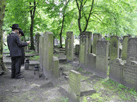
Rabbi Shlomo Bistritzky’s hand trembles as he opens the lock of the ancient cemetery in Koenigstrasse Altona.
The gate creaks open, and in an instant, we feel as though we’ve been transported back 300 years, to the shining days of Altona, Hamburg, and Wandsbek — or as they’re known in Jewish history, the Kehillos AHW, from which sprouted forth hundreds of dayanim and rabbanim. The joint rabbinical court of the three communities wrote dozens of seforim and produced tens of thousands of halachic rulings — all lost in the oblivion of the Holocaust.
Autumn leaves cover the dusty headstones. Torah scholars of enduring stature. Even the blurred letters of the headstones conceal a glorious Torah world that produced such mighty forces as Rav Yonasan Eibeshitz and his spiritual rival, Rav Yaakov Emden. The lettering is blurred with age, difficult to decipher. If not for our guide, Hamburg shaliach Rabbi Bistritzky, for whom the paths of the cemetery are as familiar as the streets of his native Tzfas, we could not have located the gravesites. It’s been centuries since anyone was buried here, and virtually no one visits, either. The keys are in the hands of the Jewish community, and visitors rarely ask for them, although almost every day of the year marks the yahrtzeit of one of the great Torah leaders interred here.
We’re in the very heart of the “Land of Altona,” near Hamburg, an important focal point of Jewish history; great men who left their mark on our people lived here. Altona was both the name of the city and the German municipal district within the greater Hamburg metropolis. The city was founded in 1535 as a fishing village. In 1664, it received township status from the king of Denmark; in 1867, it became part of Prussia; and in 1938, it was incorporated, along with a number of other towns, into the city of Hamburg.
Create a free account to keep reading.