What's next for Israeli politics?
Two axioms of recent Israeli politics were corroborated in last week’s election: that Benny Gantz can’t form a government without the Arab Joint List, and Likud challenger Gideon Saar’s thesis that the right can’t reach a 61-seat majority with Binyamin Netanyahu at its head.
As of this writing, Israel’s political deadlock is ongoing, the political establishment is in total disarray, and no one has a solution. The Israeli public turned out to vote with surprisingly high participation of 71.5%, more than in either of last year’s elections. Despite that, Israel remains split right down the middle. Those who voted for the left, Lieberman, and the Arab Joint List want to see Netanyahu gone. Netanyahu, meanwhile, shored up his position within the right-wing bloc. The problem is, his best effort brought him up three seats short of forming a government.
Theoretically, Gantz could form a minority left-wing government of 47 seats (33 Blue and White, seven for Lieberman, and seven for Labor-Gesher- Meretz) with outside support from the Arab Joint List’s 15 seats, who would block any no-confidence motions. If Gantz could pull that off, it would be the first time in Israel’s history that a government was dependent on the Arabs.
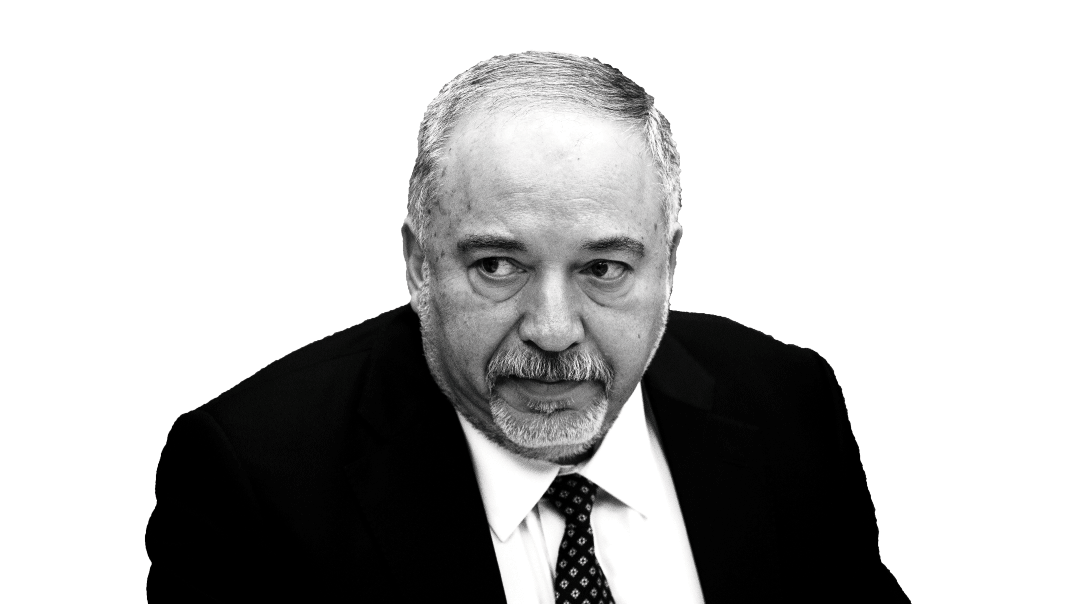
The key figure is still Avigdor Lieberman of Yisrael Beitenu. Lieberman, who attacked the Arab Joint List throughout the campaign, surprised many when he expressed willingness to recommend Gantz for prime minister in the current round of consultations with the president.
Create a free account to keep reading.