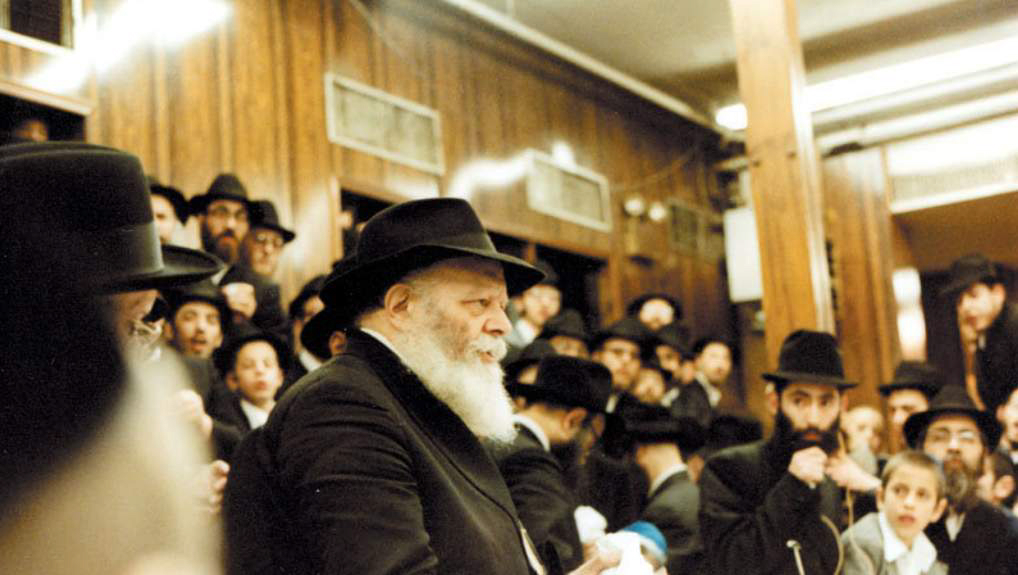
The Lubavitcher Rebbe inspired untold numbers of people through his farbrengens, correspondence (he received more mail daily than anyone else in the US besides the president), and personal audiences. While there are many fascinating stories about gedolim from all circles, “we’re getting the real stories from the people they happened to,” says Yechiel Cagen, director of an ambitious project called “My Encounter with the Rebbe.”
Under the auspices of Jewish Educational Media, Chabad-Lubavitch’s audio, video, and photographic archive and production house, Cagen has in the last ten years collected over 940 interviews and over 15,000 pages of transcripts of people from all walks of life — from roshei yeshivah to prime ministers to Israeli generals — who’ve willingly shared their personal encounters in front of the camera.
For Cagen though, it’s a race against time. “Many of the people who had the longer, in-depth conversations with the Rebbe in the 1940s, ’50s, and even ’60s — are no longer alive.”
How does Cagen know the stories all these people tell him are accurate? “As historians, we need to make sure we’re getting good information,” he explains. “After a pre-interview, we discuss the material: Does the story add up? Does it make sense? We’ll check with others to make sure the person isn’t misremembering.”
But while most of his work is focused on the past, Cagen says it’s really all about the present. “People hear things that the Rebbe told someone 60 years ago, and in those words, many find guidance to life’s challenges today. What we’re doing is bridging the past and the future.”
Here are some of those stories.
One year, I took a sabbatical to write a book, when I get a call from Lubavitch. I think it was Rabbi Groner, one of the Rebbe’s secretaries, and he said, “We understand you have a sabbatical. The Rebbe wants to meet with you.”
You can imagine what a fantastic thing that was, a private meeting with the Rebbe at his request. I say, “Why does the Rebbe want to meet me?”
He says, “The Rebbe would like you to go to the Far East. We have a list of places — Australia, New Zealand, Singapore, Bangkok, Hong Kong, Tokyo — to draw Jews closer to Judaism.”
“You want me to go raise money for Lubavitch?”
They said, “Who’s talking about raising money? We will take care of all finances involved, hotels… We’ll put you up all over. We have Lubavitchers in every one of these places. We know that you can speak well and that you can give lectures and teach about things that will draw Jews closer…”
Now, I don’t have a beard, I don’t look like a Lubavitcher, I don’t wear a black hat; I look like a Modern Orthodox Jew. I say, “Are you sure you have the right person?”
And they say, “We know everything about you.”
So I come in, and the Rebbe explains to me that they have emissaries in these various places. “We want to you go there, talk to Jews and draw them near. Teach them, tell them the things that you, as a rabbi and a teacher, know could ignite the spark that’s in their souls.”
I spent almost three months going to all these places and giving lectures everywhere. After I came back, I met with the Rebbe again. He congratulated me, told me he was very happy, and then he said, “I want to tell you something. I knew this about you — you’re a chassid in camouflage.” He saw the inside, not the external. Really, he understood that every Jew is just in camouflage.
Rabbi Benjamin Blech is a lecturer, author of 12 books on Judaism, and was rabbi of the Young Israel of Oceanside for 37 years.
y belief that it’s possible for people with genetic disorders, chromosomal disorders, to be turned into normal functioning individuals and good, practicing Jews, was a daring thing, because at that time people didn’t believe it was possible. People would ask me, “How do you dare tell people that this child will ever be able to speak? How do you dare say that this child will be able to read? To finish school? To go to yeshivah?”
Much of this power of belief came from my interactions with the Rebbe. Wherever I traveled for my work, parents would contact me: “The Rebbe wants you to see our child.” One particular case involved a boy from a European country who was considered mentally defective and placed in a school for deficient children. But the school wasn’t Jewish, and he learned real problem behaviors there.
The father wasn’t a very religious person, but he came to the Rebbe. The Rebbe told him to bring his son to me. So the boy came to Jerusalem. We taught him to read. He would sit in my office with a sefer Tehillim. The Rebbe told him to finish the sefer every week, which he did for the three years he was at our institute. We were already patting ourselves on the back, when this young man got in with a horrible crowd and ran away.
I spoke to the Rebbe about the situation. “Don’t give up on him,” he said. “Don’t let him out of your hands. Continue.” He even suggested someone who could take him out of that place. I didn’t think it would be possible, but the Rebbe said to do it.
So I sent somebody to extricate this young man from these terrible people — by that time there was no sin he was not involved with. But he came back. He’s now the father of four children, two of them learning in yeshivah, and they are the only grandchildren of this family who have brought the grandparents nachas.
You might say I’m a “good psychologist,” but usually in such cases we raise our hands and give up. Not the Rebbe. I must tell you something: Psychology, as it is taught, is very limited in terms of our understanding of the other. It’s limited by how we see ourselves. But the Rebbe saw people differently. The way he said, “Yes, do it!” means he saw each person as something that comes directly from a G-dly source.
Create a free account to keep reading.