When the holy Arizal came to two Yerushalmi sages in a dream and begged them to open a yeshivah for learning Kabbalah, he promised that the study of the concealed Torah would bring the Shechinah back to Jerusalem from its exile. A hundred years later, in a quiet corner not far from the hawkers at the bustling shuk, the elderly scholars of Shaar Hashamayim continue to refract the light revealed by Rabi Shimon Bar Yochai.
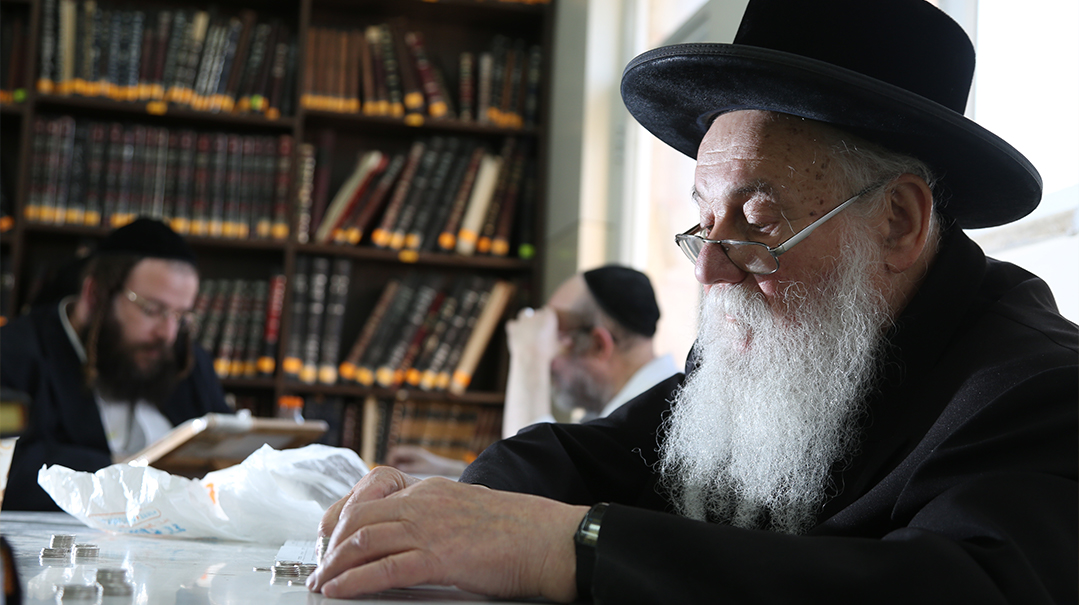
Once the pidyon hanefesh ceremony concludes, Rav Gross, who leads the yeshivah together with Rav Yaakov Meir Schechter and Rav Gamliel Rabinowitz, is happy to talk about it — although he stresses that this is not what the yeshivah is all about. If someone is looking for a house of amulets, incantations, and mysticism, 71 Rashi Street isn’t the right address.
Still, there is a tradition, and Rav Gross explains the process. “When a person is deathly ill,” he says, gently introducing me to the world of mysticism, “the tzelem Elokim within him departs. In Sefer Tehillim, the pasuk says, ‘Only with the tzelem will man walk.’ In other words, the tzelem Elokim of a person is what holds his neshamah inside his body. The tzelem is what makes it possible for a person to live. A person who is ill must be given a new tzelem, in order to spare him from death. The Rashash [Rav Sar Shalom Sharabi ztz”l, an 18th century kabbalist and one of the greatest experts in kavanos (meditations)] revealed this tikkun, which is performed with 160 silver coins, since the gematria of the word ‘tzelem’ is equivalent to that of ‘kesef’ [silver]. Through tzedakah, which saves a person from death, the ill person receives a new tzelem and can continue living.”
The Rosh Yeshivah details the procedure: “First I recite the Names of judgment, and then I pronounce the Names of mercy. Thus, we ‘sweeten’ the judgment of the person who is ill, changing his fate from one of strict judgment to one of mercy. Through the mercy, he is cured.”
The Rosh Yeshivah, evasive about the success of this “treatment,” says he knows of one case where a comatose patient woke up. But later, an elder talmid at Shaar Hashamayim pulls me aside and whispers, “The Rosh Yeshivah is very modest, and he hasn’t told you everything. We’ve clearly seen wonders here, how people have been extricated from very difficult situations.”
Create a free account to keep reading.