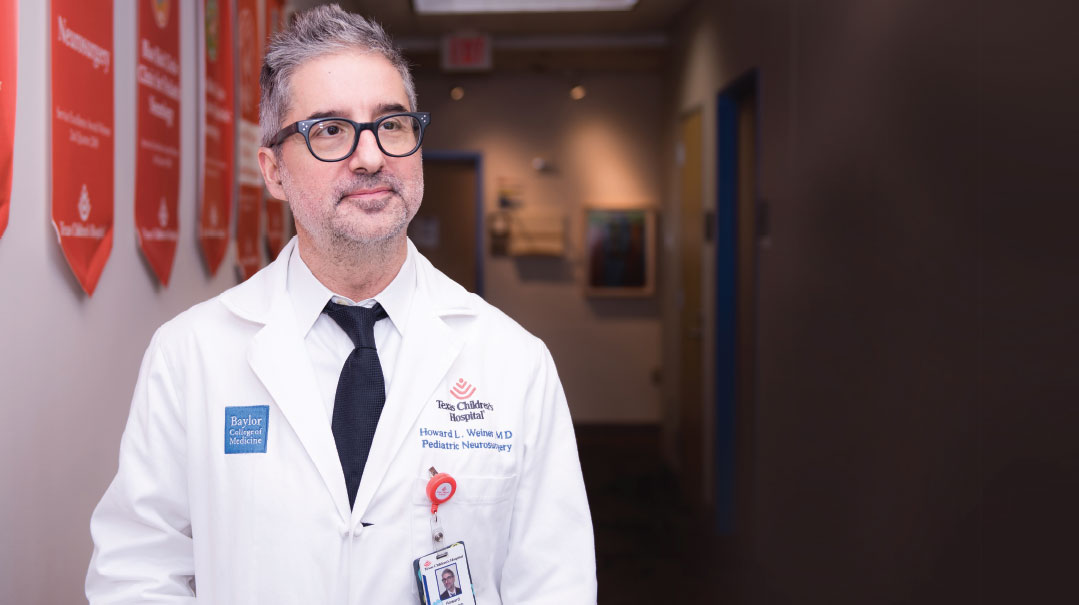
At Texas Children’s Hospital, pediatric neurosurgeon Dr. Howard Weiner heals the smallest patients, fusing top of the line medical technique with genuine caring
He had excellent teachers at Ramaz, notably Rabbi Jack Bieler and Rachel Taub Weinstein. “At Ramaz, my eyes were opened to the idea that you can be a religious Jew and still be a professional fully engaged in the world,” he says. He also absorbed the influence of his paternal grandfather’s side of the family, frum people who lived in Boro Park (one cousin is Heshy Kleinman, the author of Praying with Fire). “I inherited that religious gene,” he says.
He attended the University of Pennsylvania before enrolling at Cornell University for medical school, where he found himself pulled toward working directly with the brain, hands-on. Is he good with his hands? “Not around the house,” he says with a ready smile. “My father was very handy — he even built a shed with a workbench for himself and a small one for me when I was a child. But my manual skills are mostly confined to the operating room.”
He avows that he possesses good spatial and navigational skills, and a strong sense of judgment and safety. “In the OR, you need to know when to push limits and when to stop; the enemy of the good is the perfect. Complications happen in the last few minutes of surgery, when you’re tired and more prone to make mistakes.”
During his residency, one of his biggest mentors and influences was Dr. Fred Epstein. Epstein, the author of Gifts of Time and If I Get to Five, was a pioneer in pediatric neurosurgery and a warm, caring physician — to the point where he once allowed Mrs. Miriam Lubling a”h to pull him off a plane to Florida to operate on a child in dire straits. Epstein was always looking for new, out-of-the-box approaches to issues deemed untreatable or inoperable, and his compassion and can-do spirit left their imprint on Dr. Weiner.
Create a free account to keep reading.