Dr. Yehuda Sabiner got his real education in the Covid ward
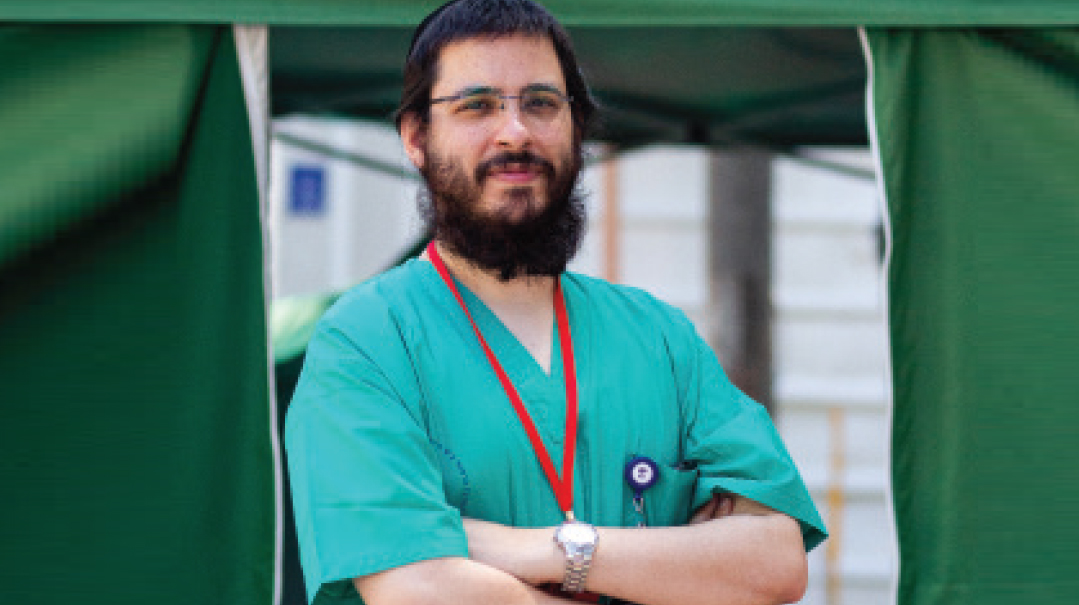
Not a typical way to start off a medical career, but then again, Dr. Sabiner isn’t your typical intern fresh out of medical school. Dressed in the full attire of a Gerrer chassid, he’s a product of Israel’s insular cheder system, with its intensive Torah learning and minimal secular study. Despite the need to add two grueling years of pre-academic courses to the already taxing seven years of medical school, and notwithstanding his family’s initial shock, he pursued his lifelong dream of becoming a doctor, without compromising his beliefs, chassidic lifestyle, or outward appearance.
Shortly after Purim, as the COVID-19 crisis unfolded in Israel with terrifying speed, it became evident that the timing of Dr. Sabiner’s internship in Sheba’s COVID-19 ward was especially fortuitous for the many chareidi patients hospitalized there. “Being in quarantine, with no one to advocate for them or even just to sit at their bedside, COVID-19 patients feel all the more vulnerable and frightened,” Dr. Sabiner relates. “For chareidi patients especially — and at times they made up over 60% of the ward— seeing me naturally put them more at ease.”
Sabiner’s internship at Sheba meant that he was made aware of the dangers of COVID-19 at a relatively early stage. “When the coronavirus was still considered a problem that existed only in faraway China, and most Israelis were worried mostly about its effect on consumer purchases, Sheba Medical Center was already going into high gear, preparing a designated ward, protocols, and plan Bs for various scenarios,” he relates. “The COVID-19 department head, Dr. Gadi Segal, told us about conversations he’d had with Italian colleagues, who described an apocalyptic situation that we found hard to believe could occur in a developed country. But when I saw the extent of the preparation, resources, and manpower our cash-strapped hospitals were funneling toward COVID-19, I realized that we were in for something unprecedented.”
Before Purim, before social-distancing restrictions, many Israelis in general, and in the chareidi community in particular, were unaware of the extent of the danger. “By this time,” Dr. Sabiner recalls, “people returning from abroad had been instructed by the Health Ministry to go into voluntary quarantine for two weeks. When someone told me that Rav Yitzchak Zilberstein had paskened that those people should still go to shul to hear the Megillah, I requested an urgent meeting with him and started giving a thorough explanation how COVID-19 was spreading throughout the world. After about ten minutes, the Rav said to call the Hebrew Yated newpaper to place an urgent letter, instructing anyone who’d been in mandated quarantine to stay home and not go to shul due to the danger of infecting others.”
Create a free account to keep reading.