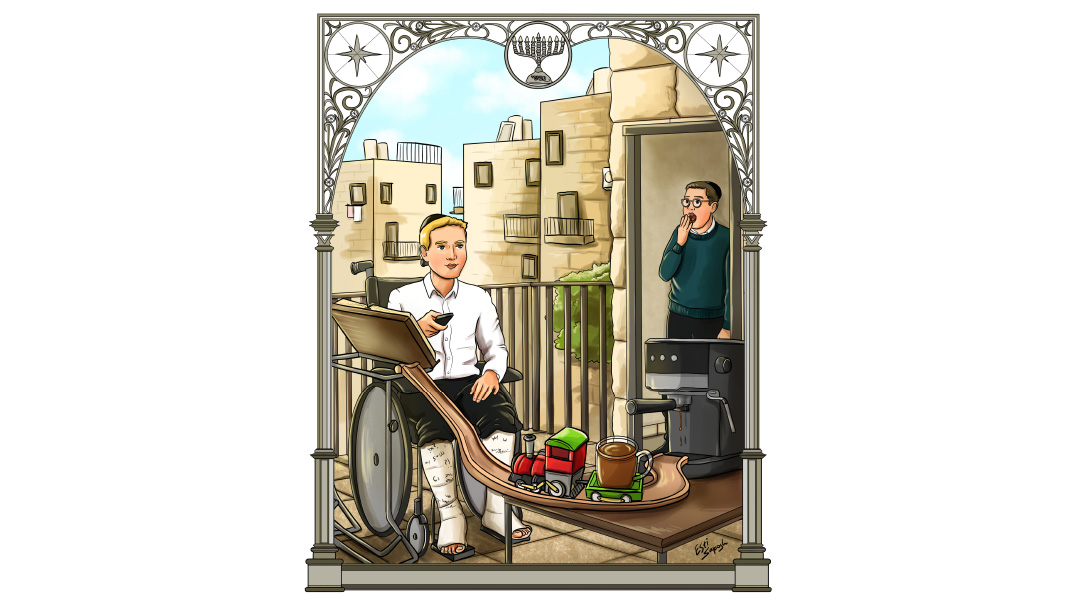
You can't share your friend's burden until you open your mind to his plight

For the past three months, a steady stream of suffering has engulfed the Jewish People. The tragedies of Shemini Atzeres were only the beginning. We have lost soldiers at the prime of their youth, chassanim awaiting their wedding day, fathers of young children. Families live in the hospital, praying for their loved one’s recovery; others live in constant dread of the dangers that abound on and under the ground.
The suffering around us isn’t just a cause for weeping — it’s a call for avodah. Our times demand from us the middah described in Pirkei Avos as nosei b’ol im chaveiro; literally, sharing our friend’s burden. Being nosei b’ol means seeing everything that your friend is going through, including the subtle difficulties you wouldn’t notice with a superficial glance. This is a necessary step toward helping your friend or providing emotional support, but it’s also significant in itself. Even when we can’t help, we must not remain indifferent to our fellow Jew’s plight. If we can’t alleviate our friend’s difficulty, the least we can do is acknowledge it.
To work on being nosei b’ol, we have to dispel a common misunderstanding. Being nosei b’ol doesn’t mean feeling other people’s pain. If we understand the severity of their hardship, we will inevitably be emotionally affected. But if we try to approach the plight of our fellow with our heart alone, we risk getting sucked into the quicksand of despair. Becoming too emotionally involved actually prevents us from helping others, because when someone is sinking in quicksand, only someone standing on firm ground can help him.
The beginning of being nosei b’ol is not to feel for the other person, but to think about him. To take a moment to step into his shoes and just think about his world, without searching for solutions. What is it like to live in his situation, day in and day out? How does it impact him physically, emotionally, spiritually, and socially? We’re often blind to the difficulties our friend experiences because we don’t think about his life. Even caring comrades can be oblivious to the most painful aspects of their friend’s situation, simply because they never thought it through.
Create a free account to keep reading.