What are the principles that a school is hewing to with the use of the Bais Yaakov name?
But let’s be real. Apologetics aside, we have girls who make it through 13 years of education, and come out saying things like, “I was just another number.” “The people teaching tzniyus don’t understand much about it.” “They led through fear and intimidation.” “There’s no room for differences or individuality” (all quotes from our survey).
Through countless informal conversations, it’s clear that a minority of students feels marginalized and resentful after years in the Bais Yaakov system. They point to unfeeling teachers, uncaring administration, and punitive approaches. Yet, as a teacher myself (and therefore, admittedly, biased), I see a different picture. In my fellow teachers I see people of nuance and compassion, not one of whom ever mentions Gehinnom (except me, but that’s because I teach about the kindness inherent in its creation). Where, I ask my interviewees, does this discrepancy come from? How do two sets of respondents — teachers and disgruntled students — describe two entirely different pictures?
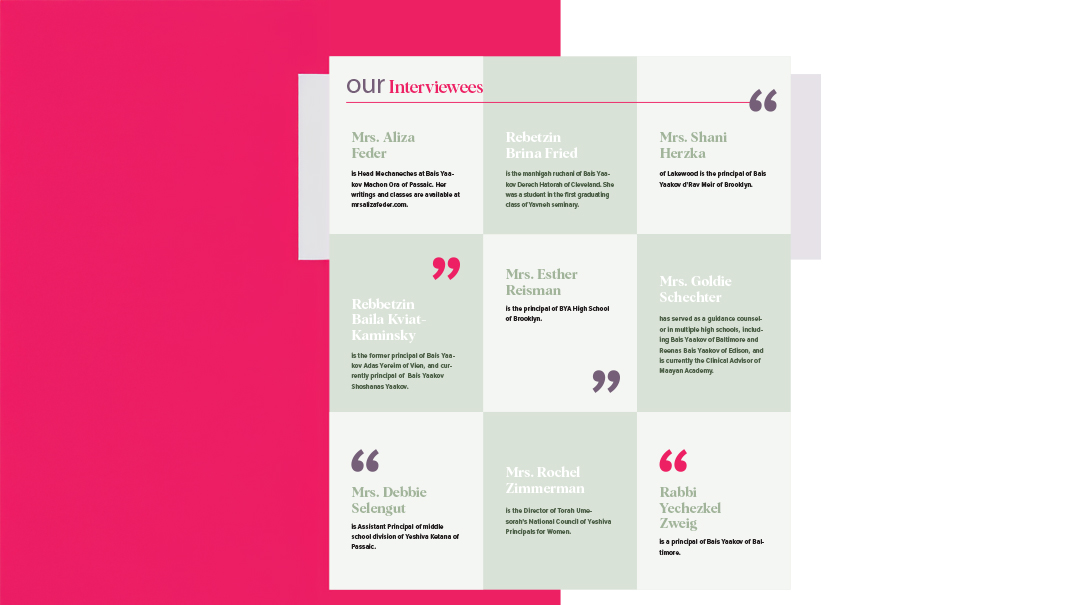
“The problem with the system is that it’s a system, and the problem with any institution is that it’s an institution,” avers Mrs. Feder. “As soon as you have a classroom with more than one student, the personalized chinuch will inevitably be compromised.”
Every system consists of people, some better and some less so. Along with the many inspiring and uplifting teachers, there will be some who are burned out or afflicted with foot-in-mouth disease. And some inspiring and uplifting teachers will have a bad day and say something catastrophically unwise. But although the hurt student may generalize from her experience to “the problem with Bais Yaakov,” it’s really the problem with people: they’re human.
Create a free account to keep reading.