Location: Philadelphia, Pennsylvania
Document: Various documents and photos
Time: 1924
Blossoming the Flowers of American Jewry
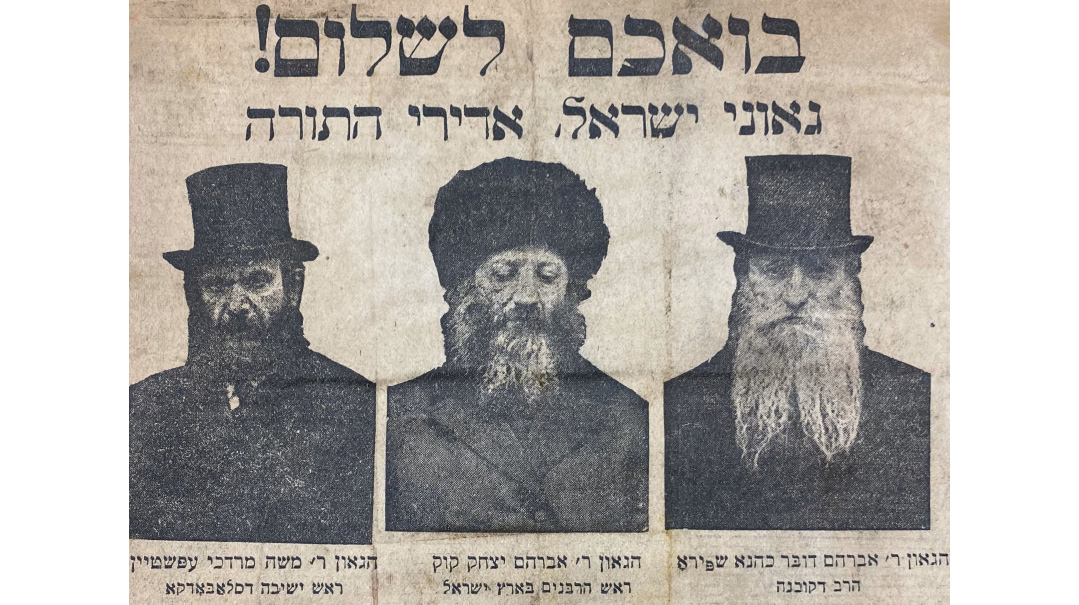
In 1924, three Torah luminaries journeyed to the US to secure financial aid for Torah centers ravaged by the First World War. While their fundraising efforts fell short of their goals, the visit of these revered figures was a landmark event that stirred the hearts of American Jews, greatly reinforcing their connections to their European counterparts and the nascent Jewish community in Palestine
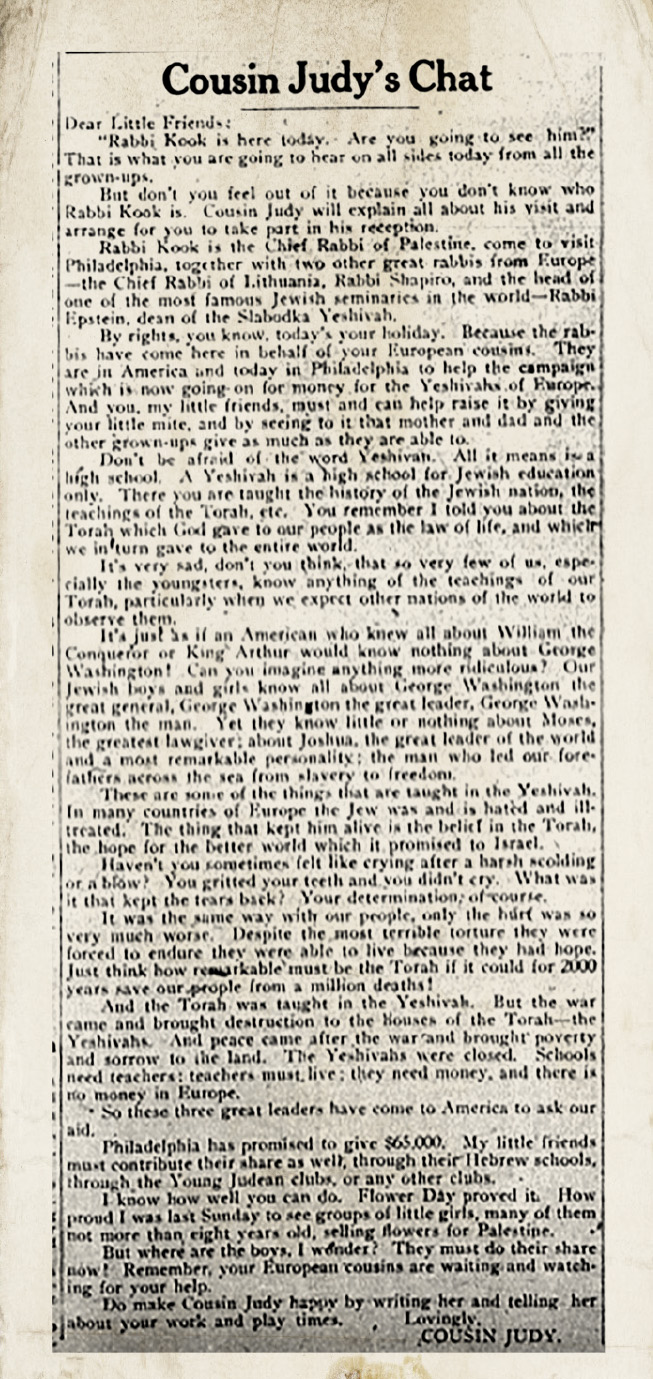
Cousin Judy’s Chat
Dear Little Friends,
“Rabbi Kook is here today. Are you going to see him?” That is what you are going to hear on all sides today from all the grown-ups. But don’t you feel out of it because you don’t know who Rabbi Kook is. Cousin Judy will explain all about his visit and arrange for you to take part in his reception.
Rabbi Kook is the Chief Rabbi of Palestine, come to visit Philadelphia, together with two other great rabbis from Europe — the Chief Rabbi of Lithuania, Rabbi Shapiro; and the head of one of the most famous Jewish seminaries in the world — Rabbi Epstein, dean of the Slabodka Yeshivah.
By rights, you know, today’s your holiday. Because the rabbis have come here on behalf of your European cousins. They are in America and today in Philadelphia to help the campaign which is now going on for money for the Yeshivahs of Europe. And you, my little friends, must and can help raise it by giving your little mite, and by seeing to it that mother and dad and the other grown-ups give as much as they are able to.
Don’t be afraid of the word Yeshivah. All it means is a high school. A Yeshivah is a high school for Jewish education only. There, you are taught the history of the Jewish nation, the teachings of the Torah, etc. You remember I told you about the Torah, which G-d gave to our people as the law of life and which we, in turn, gave to the entire world. It’s very sad, don’t you think, that so very few of us, especially the youngsters, know anything of the teachings of our Torah, particularly when we expect other nations of the world to observe them?
It’s just as if an American who knew all about William the Conqueror or King Arthur would know nothing about George Washington! Can you imagine anything more ridiculous? Our Jewish boys and girls all know all about George Washington, the great general, George Washington, the great leader, George Washington, the man. Yet they know little or nothing about Moses, the greatest lawgiver; about Joshua, the great leader of the world and a most remarkable personality; the men who led our forefathers across the sea from slavery to freedom. These are some of the things that are taught in the Yeshivah. In many countries of Europe, the Jew was and is hated and ill-treated. The thing that keeps him alive is the belief in the Torah, the hope for the better world that it promised to Israel.
Haven’t you sometimes felt like crying after a harsh scolding or a blow? You gritted your teeth, and you didn’t cry. What was it that kept the tears back? Your determination, of course. It was the same way with our people, only the hurt was so very much worse. Despite the most terrible torture they were forced to endure, they were able to live because they had hope. Just think how remarkable must be the Torah if it could, for 2000 years, save our people from a million deaths!
And the Torah was taught in the Yeshivah. But the war came and brought destruction to the houses of the Torah — the Yeshivahs. And peace came after the war and brought poverty and sorrow to the land. The Yeshivahs were closed. Schools need teachers: teachers must live; they need money, and there is no money in Europe.
So these three great leaders have come to America to ask for our aid. Philadelphia has promised to give $65,000. My little friends must contribute their share as well, through their Hebrew schools, the Young Judean clubs, or any other clubs. I know how well you can do. Flower Day proved it. How proud I was last Sunday to see groups of little girls, many of them not more than eight years old, selling flowers for Palestine. But where are the boys, I wonder? They must do their share now! Remember, your European cousins are waiting and watching for your help.
Lovingly,
COUSIN JUDY.
(COUSIN JUDY was the pen name used by an Orthodox woman who wrote regular English advice columns to the youth in Philadephia’s Yiddishe Velt newspaper. While her identity remains unknown, we have some suspicions about who she might have been.)
The Johnson-Reed Immigration Act of 1924 was a watershed moment in both the history of the United States and Jewish history of the 20th century. Over decades of largely unrestricted immigration, nearly three million Jews had escaped from economic hardship and governmental repression in Eastern Europe to the promise of the New World. This came to an end in 1924, when the US Congress curtailed further immigration through draconian quotas. While the Johnson-Reed Act had far-reaching consequences for the millions of Jews in Eastern Europe hoping to immigrate, it also unintentionally influenced the trajectory of American Jewry itself.
Within the flourishing immigrant communities, there was a tacit understanding that the flow of immigrants from the alte heim would never cease. That meant a limitless supply of spiritual guidance: religious leaders and educators arriving on American shores on a regular basis. This unspoken reliance on the bridge to the old country meant that much of the American Orthodox infrastructure of the early 20th century was underdeveloped.
All of that came to a sudden halt with the Immigration Act of 1924. The flow of immigration almost instantly dried up, and American Jewry was forced to mature, define its identity, and find its own distinctive path. This took many years and was only fully realized after the destruction of European Jewry during the Holocaust. But the seeds were planted while Congress deliberated the legislation. Exactly 100 years ago, three great Torah leaders visited the United States and infused the Jewish community with a sense of identity and mission. This historic sojourn paved the way for a confident, independent, and traditional American Jewish community to take a leadership role in world Jewry.