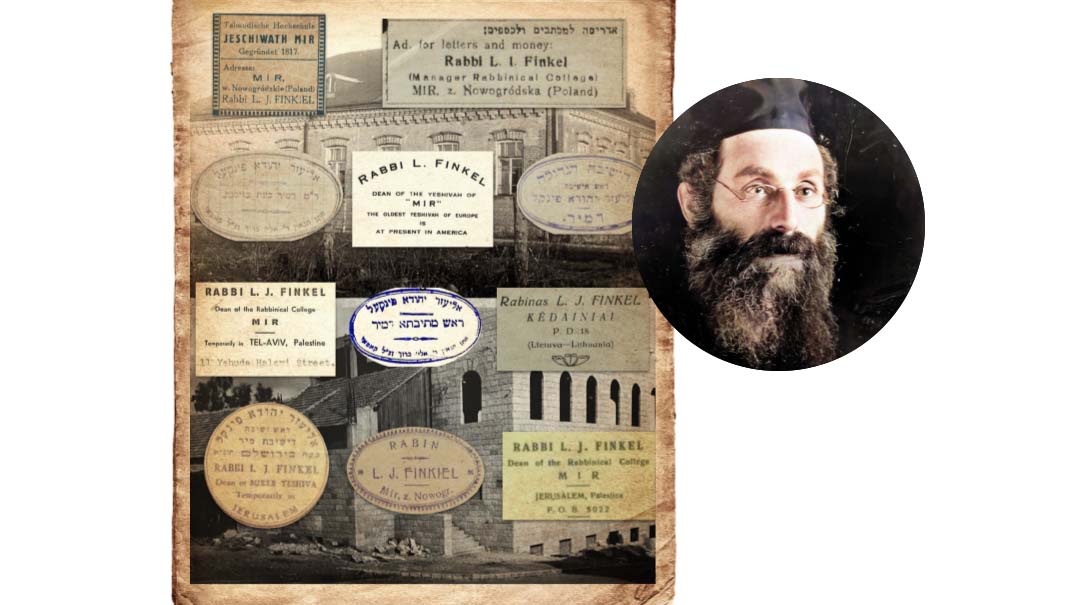
The interwar period was marked by constant traveling on behalf of the yeshivah, which necessitated stamps in no less than four languages
For most yeshivos in the Russian Empire, the 19th century was a period of relative stability. The Mir yeshivah, nestled in a small shtetl in the Minsk district, was one of the oldest in the region. Nurtured by generations of the Tiktinsky family, it grew in both numbers and prestige during the half-century tenure of Rav Chaim Leib Tiktinsky. Shortly after the turn of the century, Rav Elya Baruch Kamai was appointed rosh yeshivah. A fire ravaged the yeshivah building in 1911, and a young son-in-law of Rav Elya Baruch named Rav Eliezer Yehuda Finkel took the initiative to fundraise and administer the rebuilding project. Completed in 1912, the impressive brick edifice expressed the hope of continued stability.
In August 1914 illusions of tranquility were shattered with the outbreak of World War I. As the war raged across Europe, the refugee Mir yeshivah went into exile, ultimately finding temporary refuge in Poltava, Ukraine. Upon the passing of Rav Elya Baruch Kamai, his son-in-law Rav Eliezer Yehuda Finkel ascended to the yeshivah’s helm (his son Rav Avraham Tzvi Kamai would inherit the Mir rabbinate). Confronting famine and pogroms amid the horrors of two world wars, his years of leadership were marked by wanderings, fundraising, and relentless rebuilding.
As a result, Rav Leizer Yudel presided over the yeshivah in a multitude of locations. First stop after World War I was Vilna, prior to returning home to Mir, Poland. The interwar period was marked by constant traveling on behalf of the yeshivah, which necessitated stamps in no less than four languages — Hebrew, English, Polish and German. At the onset of World War II, the yeshivah once again went to Vilna and then spent several months in Keidan, Lithuania. Rav Leizer Yudel himself arrived in 1941 in Eretz Yisrael, then called Palestine, and established a temporary base in Tel Aviv and then Jerusalem. Was it the decades of instability that led him to add “temporarily” to the Yerushalayim location? That temporary location seems to be more permanent than ever!
Rav Leizer Yudel’s letters themselves were unique in that many of those sent to the United States were written in a beautiful English cursive. While Rav Leizer Yudel himself was not proficient in the language, his daughter Chana Miriam (later Rebbetzin Shmuelevitz) was taught the language in Warsaw as a teenager. This skill came in handy again during the war years, when English was often the language used in Shanghai’s international settlement.
Create a free account to keep reading.