Rav Chaim Brisker’s impact upon the Lithuanian Torah world is almost immeasurable. Students of his in the Volozhin yeshivah went on to lead some of the most prestigious prewar yeshivos, and his name became synonymous with the new analytical approach to learning that electrified the yeshivah world for generations to come. In addition to his transformative impact on the way Gemara is studied, there were tangible memorials to him in the form of yeshivos that carried his name.
Shortly following the passing of Rav Chaim in 1918, Yeshivah Toras Chaim in Warsaw was named for him. Loosely affiliated with Rav Itche Grodzenski’s network of Torah institutions in Poland’s capital, the Toras Chaim yeshivah was headed by Rav Chaim Brisker’s son-in-law Rav Hirsh Glikson. Rav Yitzchok Zev Soloveitchik, the Brisker Rav, taught there for a short time as well prior to succeeding his father in the Brisk rabbinate. Toras Chaim served as one of the leading yeshivos in the city until they perished in Treblinka with the rest of Warsaw Jewry during the Holocaust.
Migrating from Warsaw to the United States was another branch of Rav Chaim’s family. Rav Moshe Soloveitchik was firmly ensconced as the rosh yeshivah of RIETS by 1929, and his son Rav Yosef Dov Soloveitchik was appointed rabbi in Boston a couple of years later. With the encouragement of his father, Rav Soloveitchik opened a yeshivah in Boston named Heichal Rabbeinu Chaim HaLevi (also known as the Boston Yeshivah) in 1932. The yeshivah functioned similarly to today’s community kollel, with an emphasis on learning and shiurim for laymen and their children.
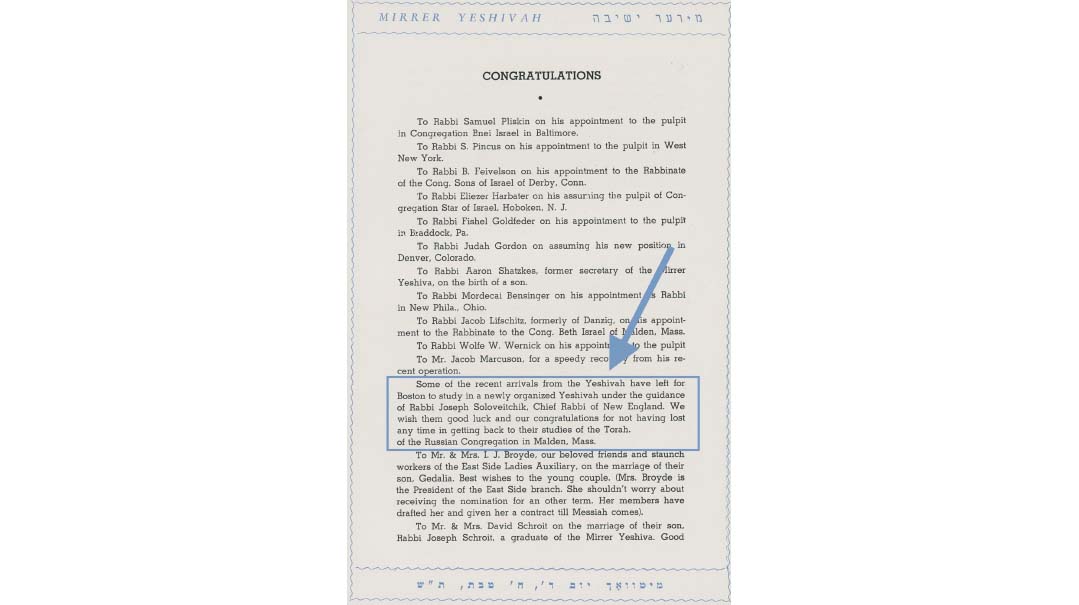
In late 1939, the Heichal grew in both size and stature, thanks to a cadre of new arrivals, at whose core stood 15 American-born European-educated (primarily Mir) yeshivah students who had returned with the outbreak of the war. They were joined by several European-born counterparts who were able to escape, as well as a few “Yankees.” In late 1941, Rav Michel Feinstein, one of the “Lions of Mir,” arrived on American shores and joined the group. In what was colloquially known as “the Kibbutz,” Rav Michel delivered shiurim during the week, while Rav Soloveitchik delivered shiurim over the weekend. At times his Motzaei Shabbos shiur would go through the night, concluding with the arrival of daylight.
Create a free account to keep reading.