Bibi must find a way to turn Trump's curses into blessings
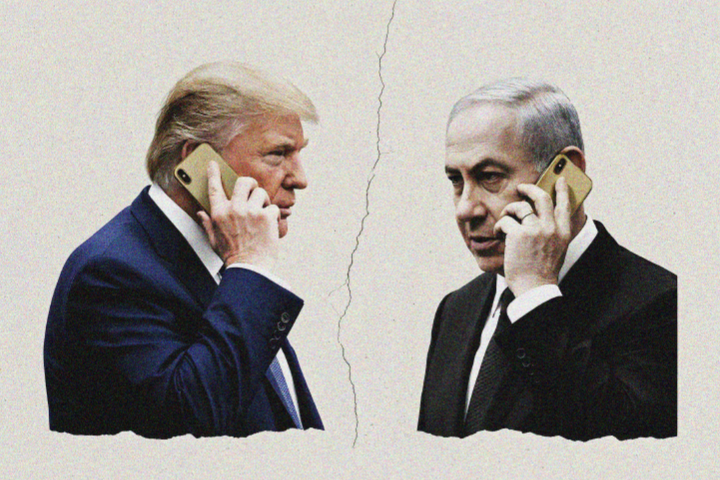
Turning Trump’s Curses into Blessings
When President Trump reportedly told Prime Minister Netanyahu — in profanity-laced terms — that Beirut and its suburbs were off-limits to IDF attacks while Washington hosted talks between Lebanon and Israel, Netanyahu dismissed it in a CNBC interview as a “tactical disagreement.” He even joked that if people thought this was a crisis point, they clearly had not heard some of the tougher conversations the two leaders had held on other occasions.
Trump’s directive became moot a few days later when Israel struck targets in Dahieh, a southern suburb of Beirut, in response to Hezbollah’s rocket attacks into Israeli territory. The situation escalated a few hours later when Iran and the Houthis fired missiles into Israel, violating Trump’s contrived ceasefire.
However, Trump’s tirade is still resonating in Israel.
There are two interesting perspectives on how to measure these developments. One holds that Trump is looking for an out card from the Iran conflict, and he’s keeping Israel on a short leash. Proof comes from Trump’s remarks to the Financial Times that he is “calling the shots” and that Netanyahu must accept any deal he makes with Iran.
The other perspective, prevalent in the Arab world, holds that Trump and Netanyahu are in cahoots, deceiving Iran and its proxies into believing a rift has opened. As proof, they cite the widening scale of IDF attacks in Lebanon and Gaza, as Israel expands its security zones.
The best way to tell which view is more accurate is to see how long Sunday’s and Monday’s attacks last. If they escalate as the week progresses, the view that Trump and Bibi used misdirection gains more credence. If things quiet down after a day or two, it’s more likely that Netanyahu felt more pressure to appease his coalition and voter base, so he ordered the IDF into action, figuring he’d make amends with Trump later.
No matter which view prevails, the days of “no daylight” between an Israeli prime minister and a US president are over. For both men, the political friction is useful if it helps them pivot to a relationship that looks and feels more like a partnership.
A February Gallup poll showed a ten-point decline in Republicans’ sympathy for Israel since 2024. An April YouGov survey, commissioned by Americans for Justice in Palestine Action, found that 56% of MAGA Republicans support attaching conditions to aid for Israel, while 90% said they were more likely to vote for candidates who put America first rather than send aid abroad.
As Republicans reassess the cost of unconditional support for Israel, Israeli voters are likewise questioning Netanyahu’s decision to tie their security so closely to Trump. A Maariv poll published last Friday showed 62% of Israelis oppose allowing Trump to dictate Israel’s military operations. In the north, residents who have come under Hezbollah fire for more than two years openly doubt whether Bibi still deserves the moniker of Mr. Security. Away from the front lines, other center-right voters believe Bibi’s promises of “total victory” on all fronts are empty and are looking elsewhere. Some may drift toward Ben-Gvir or Smotrich, which could splinter the right and hand an election victory to the center-left, a result Bibi must avoid at all costs.
Before facing the voters in the next Israeli election, Bibi needs to make progress toward his goal of weaning Israel off US military aid over the next decade.
American and Israeli negotiating teams are already hashing out a military Memorandum of Understanding (MOU) that would replace the current annual $3.8 billion military aid package with mutually beneficial joint investments in research, development, and co-production of weapons and munitions.
And both sides are motivated to finish the framework before the elections. Trump’s grip on Congress is fragile heading into the November midterms. He wants to show MAGA voters that he is reducing America’s exposure to foreign aid commitments and that Bibi is his junior partner, not a senior advisor.
Netanyahu faces a different but parallel challenge. After absorbing more criticism last week that Israel is becoming a vassal state of America, Bibi must show that Israel can stand on its own two feet and has greater leeway to act in its security interests without asking for American permission.
If managed properly, last week’s curses could be transformed into blessings, thereby maintaining and strengthening the enduring strategic alliance that benefits both nations and better positioning both to address increasingly complex regional geopolitical challenges that aren’t going away. Listening Is a Learned Skill
If the leak about Trump’s anger at Bibi wasn’t enough to stir controversy last week, the New York Times added fuel to the fire by reporting that Israel allegedly wiretapped calls involving top administration officials.
The Times named Steve Witkoff and Elbridge Colby as targets, two men with access to information Israel would plainly want. Witkoff has been deeply involved in Iran diplomacy, while Colby has hosted Israeli and Lebanese military delegations during the current negotiations.
Israel’s embassy in Washington and the White House issued firm denials.
When there is smoke, there is not always fire. Netanyahu says Trump sidelined him during the Iran talks, and there are signs Israel has reason to worry about what it may not be hearing directly. Media reports say Witkoff and Jared Kushner visited Oak Ridge National Laboratory in Tennessee to consult nuclear experts, reportedly about Iran’s enriched uranium stockpile.
If Israel feels sidelined, it has reason to want more information. That is a motive, not proof that it obtained anything by eavesdropping.
A bigger story might be America’s own negligence. The Times pointed out that some high-ranking Trump officials fly private planes and handle national security matters on personal devices, making them vulnerable to surveillance. Considering all the criticisms Trump directed at Hillary Clinton for using a private email server for official State Department work during the 2016 campaign, one would expect that he would instruct his top people to be more careful.
Ukraine is the world’s most militarized nation, spending 39.6% of its gross domestic product (GDP) on its military in 2025. Israel ranks third, spending 7.8% of GDP on the military. The US is in 23rd place, spending a whopping $954 billion on defense, but that’s just 3.1% of its economy.
Source: Visual Capitalist
The Rich Get Richer
A record 33% of the total wealth of the US household sector was in stocks at the end of 2025, according to Federal Reserve data. However, it’s the richest 10% of American households who own about 87% of that total household stock market wealth of $67.77 trillion.