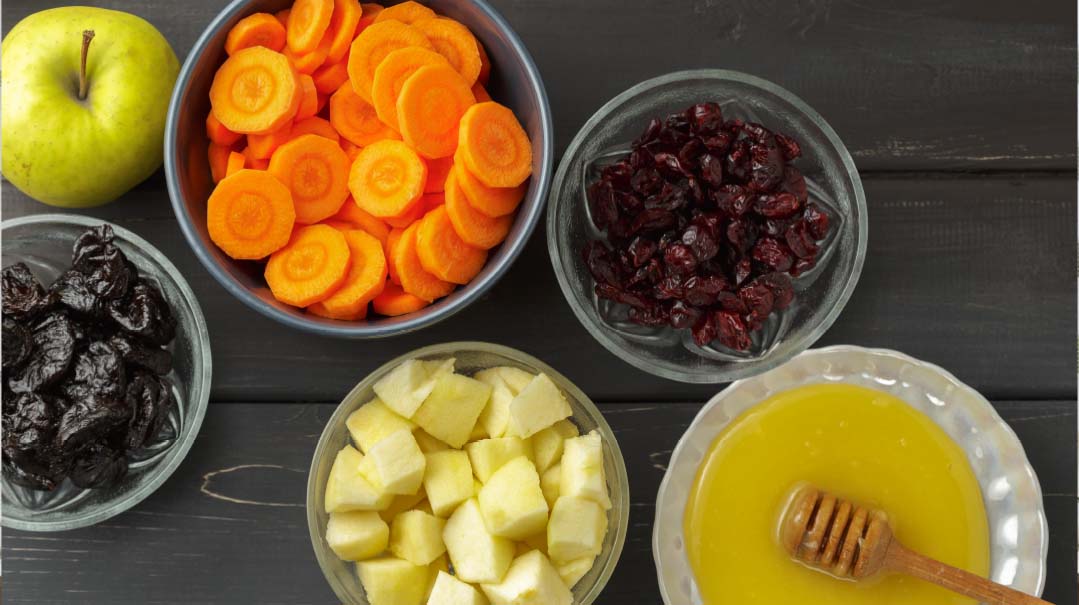
I grew up in an Ashkenazic home, but as a child I also grimaced over tzimmes. Sweet was for cookies, not vegetables! But tzimmes was a staple of our Rosh Hashanah table, as it is for so many, and I warmed up to the idea over time.
I got out of having to make tzimmes myself by marrying a Moroccan. But even Moroccans eat sweet vegetables on Rosh Hashanah. I make a butternut squash soup every year, as per my in-laws’ minhag, and when I braise my lamb’s head (lamb cheeks, really), I add the simanim of gourd (more squash) and carrots, flavoring it with turmeric and cinnamon. Not so different, really…
It turns out that Ashkenazic tzimmes has a pretty interesting background. Alex Rapaport, the executive director of Masbia Soup Kitchen, says that tzimmes was first made popular by Rav Shlomo Ganzfried about 150 years ago, when he mentioned it in connection with Rosh Hashanah in his Kitzur Shulchan Aruch. “In Europe, people didn’t have dates and pomegranates and the other, more exotic foods that are part of the Sephardic Rosh Hashanah meal,” Mr. Rapaport explains. “So aside from the head of a fish — which was no novelty because people always ate the whole fish back then — and apples in honey, Ashkenazim only had carrots to use for a siman.”
Cut into orange and gold coins, carrots are reminiscent of the plenty we hope to receive in the new year. The Yiddish word for carrots, meren, can mean “plenty” or “more,” and is related to the Hebrew word marbeh. The Hebrew term, gezer, sounds like gezeirah and invites the yehi ratzon “shetigzor aleinu gezeiros tovos,” that Hashem should issue us only good decrees.
Create a free account to keep reading.