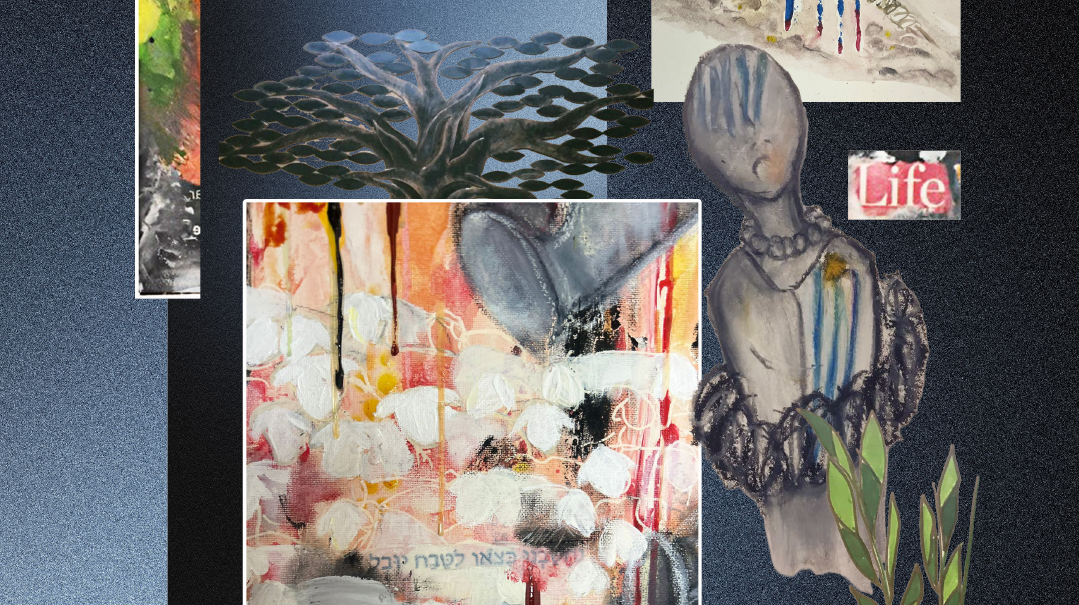
Chava Erlanger uses art to help people transform themselves, one brushstroke at a time
I grew up in Israel during a time when war wasn’t just history — it was our present. I remember the sirens of the Gulf War, the sealed rooms, the fear in the air. But even as a teenager, art was my escape. General Schwarzkopf was our hero back then, and I cut out his picture to decorate my gas mask.
Looking back, I realize I was creating a self-portrait, making a collage — almost like taking an emotional selfie. That was the first time I used art as a way to cope with my feelings. Even unconsciously, there was this urge to express myself, to tell people something.
What I didn’t understand then was that this impulse connected me to something deeper —the trauma we all carried then as children growing up in the shadow of the Holocaust. For us, the Holocaust wasn’t ancient history; it was blood and bone, woven into our family stories and fears. My siblings each processed this inheritance differently. Some carried it quietly; others seemed almost untouched. For me, it was always there, an invisible thread pulling at my heart.
As an older teenager, I yearned to be a nurse. But although I had superior verbal skills and could speak multiple languages, I struggled with math and writing in school, and those dreams seemed impossible. (Only years later did I discover that I had undiagnosed ADHD and dyslexia, not well-known conditions then).
Create a free account to keep reading.