While Salonika served as a haven for centuries, it couldn’t save itself from the Nazi onslaught. Could this ancient city of refuge come to life again?
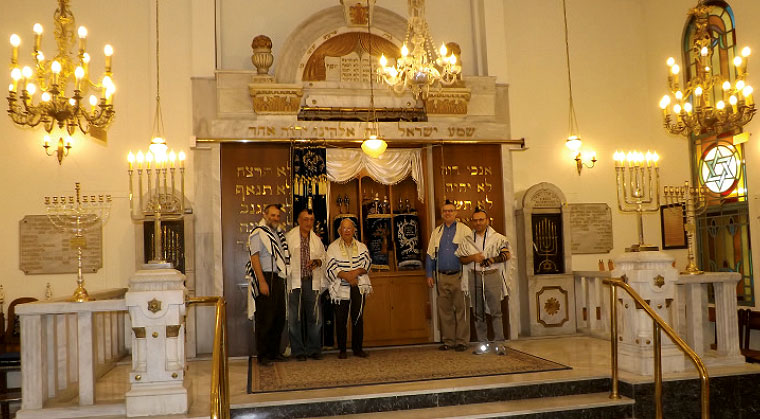
ACTIVE INVOLVEMENT Yad Lezikaron is Salonika’s only active shul. The community pays people to make sure there’s a minyan. The shul is on the ground floor of an eight-story commercial building owned by the community. Often there are community-wide Friday night dinners that attract upward of 100 people (Photos by Ari Z. Zivotofsky and Ari Greenspan)
I t was known as “La Madre de Israel” (the Mother of Israel). And probably the only city of this size and importance in the entire Diaspora that had a Jewish majority. A city in which even the non-Jews had to speak Judeo-Spanish Ladino in order to engage in commerce.
Thessaloniki or Salonika as many know it was one of the most important trading ports on the Mediterranean — and by the early 16th century Jews constituted over 50 percent of the population of this central Greek metropolis. Jews were so dominant that the lifeblood of the city the large port was closed on Shabbos and Jewish holidays.
For over 450 years Salonika was the main center of Jewish Sephardic life and in the early 20th century there were 35 Ladino newspapers in the city. We were told that when the Nazis invaded Greece they were able to recognize some of the Jews by their inability to speak Greek despite their families having lived there for centuries.
Create a free account to keep reading.