At first glance, they’re just random splashes of color. But as your eyes adjust, you might find some surprising images of Yoel Turgeman’s inner world
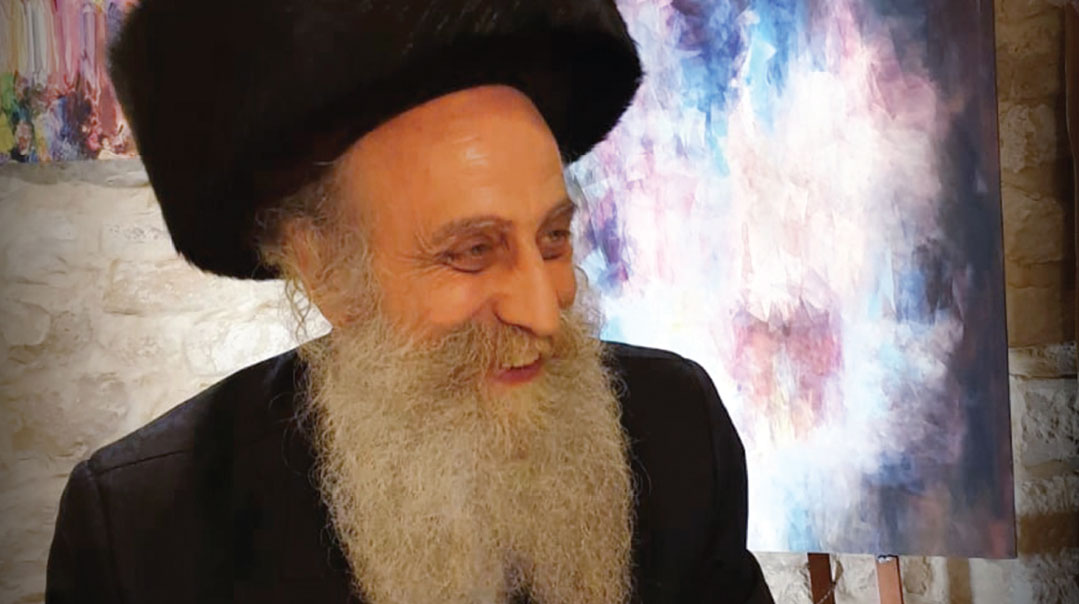
“Try to look deeper,” he says encouragingly, and I’m glad he’s not insulted. I sharpen my gaze, continuing to stare at the various shades of blue, shifting my eyes to brown hues and glimmering sparks, and then suddenly, emerging out of this chaotic mass of color, I see it — a man standing in prayer. A deeper look and he seems to be leaning on a staff for support.
Before I can answer, Turgeman is talking again. “Now,” he says, “you are beginning to listen to your neshamah. You’re no longer looking at it only with your intellectual understanding. You broke through the constraints of logic, and that’s how you grasped it. I’ll tell you the truth, the ones who appreciate my paintings most are children under ten or people over seventy-five. Their vision is pure — the young ones because it hasn’t yet been corrupted, and the older ones because they’ve lived long enough to know that what you see at first glance is not necessarily reality.”
Yoel Turgeman, who splits his day between painting and learning Torah, recently completed his 613th painting, (“my taryag picture”), and while the world record holder was Palbo Picasso (he created an estimated 13,500 paintings), it might be a record for a living artist. Yet if you’re expecting to see a gallery full of pastorals or portraits, you’re missing his secret. In maybe ten percent of his works, you can say definitively “that’s a leaf,” or “that’s a flower.” All the other paintings are streaks of color that leave an open window for each person’s unique interpretation.
French-born Turgeman, 59, was a talmid of Rav Chaim Chaikin, the rosh yeshivah in Aix-les-Bains and a primary disciple of the Chofetz Chaim. But although he had a “litvish” Torah education, he’s a spiritual mix. He comes from a line of illustrious Moroccan rabbanim — his grandfather was Rav Moshe Turgeman, the rebbi of the Baba Sali.
Create a free account to keep reading.