THE CURRENT → A FEW MINUTES WITH Issue 999 · February 14, 2024

United Front  

As cracks in the wartime coalition widen, Gideon Saar urges Israel’s warring politicians to hold their fire
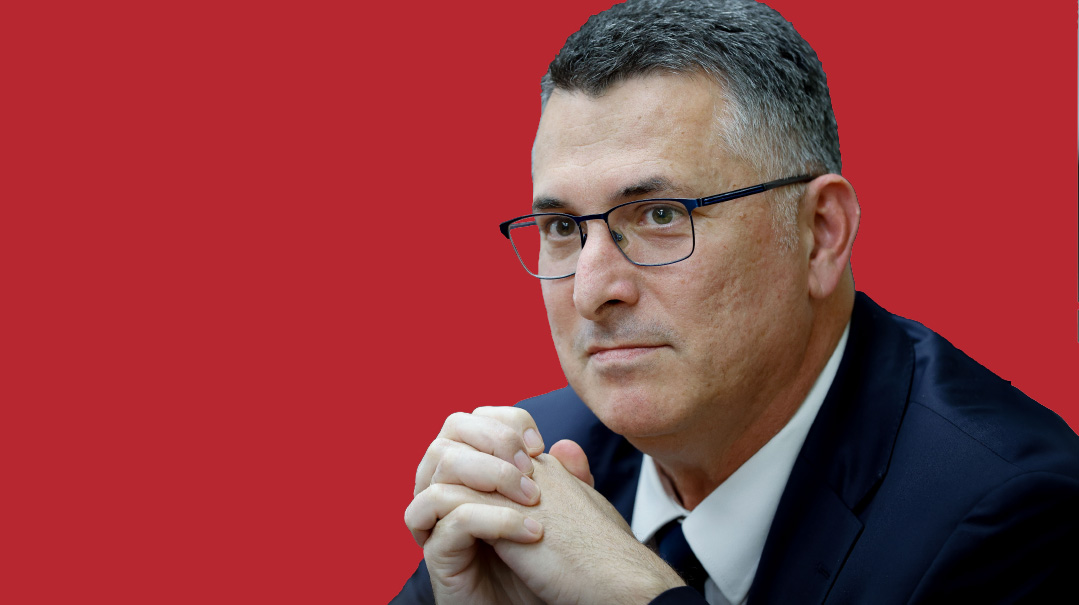
United Front  
Photo: Flash90
He may not be a member of the war cabinet, but New Hope Chair Gideon Saar is undoubtedly a key factor in the stability of Israel’s emergency government. If not for him, National Unity’s Benny Gantz and Gadi Eizenkot may never have stood up to opposition leader Yair Lapid and the left’s pressure to hinge entering the wartime unity government on ousting right-wing ministers Bezalel Smotrich and Itamar Ben Gvir.
And as the cracks in the wartime coalition have widened, Saar’s influence has been no less decisive in holding it together. His announcement that he intends to remain in the government as long as the fighting continues, and as long as the Israeli government is taking the necessary steps to eradicate Hamas, has forced Gantz to think twice about resigning. From the lofty height of 40 predicted seats in the polls, Gantz counted actual votes in the current Knesset and realized that even if he resigns, Gideon Saar’s New Hope, which controls a third of National Unity’s 12 seats, would remain in the government.
This is the petty politics that Saar prefers not to elaborate on. He rarely offers personal criticisms, insisting we focus on substance in the course of our extensive interview. He has reservations about the management of the war, including the humanitarian aid falling into Hamas’s lap, but he also has a vision of his own — from the victory over Hamas, the challenge posed by Hezbollah, the American administration’s pressure for a Palestinian state, to the issue of “the day after.” And at the end of our wide-ranging interview, we couldn’t help but ask about the political day after, too.


Give us a snapshot of the current security situation from your point of view. Where are we headed? What are the objectives? The public is confused.

The security cabinet made decisions about the goals of the war at the outset: dismantling Hamas’s military and governmental capabilities, removing the threat and returning the hostages, and all that stands. The goals that were set are ambitious, but they are achievable goals that require perseverance, determination, and willpower. This will affect Israel’s standing in the region and the world for many years to come, so we can’t backtrack.

And do you see the government sticking to the goals until they’re achieved? What’s the ultimate “victory picture”?

The victory picture is the unequivocal defeat of Hamas. One idea I’ve raised is allowing Hamas’s military wing to lay down its arms and leave the Gaza Strip in exchange for releasing the hostages. I think this proposal would help in the battle for global public opinion, even if it’s not very likely to materialize. In any case, there’s no alternative to Hamas’s defeat, and any result other than Hamas’s destruction means that this was just “another round” [in an ongoing conflict] — that Hamas will rebuild its capabilities, both as a governmental entity and as a military force, and eventually reemerge as a threat to Israeli citizens and repeat October 7. That’s their stated intent, this is not subject to question. So there’s no substitute for absolute victory — whatever the cost, we must bear it for the survival of the Jewish People.

What about the perception that we’re begging them for a deal and that by responding at all, they’re doing us a favor? Is it even possible to reach a favorable agreement under these circumstances? Because right now, it seems that the world sees us as pushovers.

I don’t think anyone perceives us as pushovers. So far, we’ve been criticized for using too much force, not too little. But it’s true that we have to change the dynamic and increase the pressure on Hamas, and not just militarily. The equation regarding humanitarian aid has to change. We can’t accept a reality in which Hamas seizes the humanitarian aid. Even if they distribute part of it to the civilian population, this undercuts one of the goals of the war, which is to destroy Hamas as a governmental entity. So this is something that has to be changed without delay.

But it seems that when it comes to this, Netanyahu is determined to let the situation continue, maybe due to American pressure.

I’m not sure, and I want to make a distinction between the principle of allowing in humanitarian aid and the question of who distributes it. When Biden pressured us to let in humanitarian aid at the beginning of the operation, on October 18, he himself made it clear that if he saw Hamas taking over the humanitarian aid, he would be the first to demand an end to it. That went into his statement as a result of a discussion between us and Secretary of State Blinken during the latter’s visit to Israel in mid-October.

Continue reading with Mishpacha.

Create a free account to keep reading.

Everything you need to stay close to Mishpacha.
← Previous installment A Bleak Report Card Next installment → Fear of Abandonment